I have a Nibe (8kw) GSHP that heats my house.
I have an outbuilding that I would like to heat that is a 30-35m pipe run one way from the heatpump to a manifold.
Originally I had thought that the outbuilding would require its own heating system (ASHP etc) but reading some information on here suggest that assuming I have enough overhead in the Nibe unit an insulated run to the outbuilding would be possible?
Your thoughts please
Wouldn’t you need a return line also?
We heat a summer house as part of the same zone as the house, we have a fan coil in there and and the pipe run is about 10m and I have run in 15mm hep2o and it works fine, no additional pumps used.
Hi Graeme,
Coincidentally, I also have an 8kW NIBE GSHP (F1145) heating a House and I built a detached Outbuilding (100m^2) last year. I opted for a separate Daikin Air-to-Air heating (and cooling) system for the Outbuilding.
What sort of heat loss are you predicting for the Outbuilding and how does that compare to the House?
What sort of temperature are you looking to maintain and would that be constant 24x7 or would you want a quick heat-up when you’re spending time in the Outbuilding?
Are you thinking about a two-pipe-in-one-duct connection in a trench, using something like this?
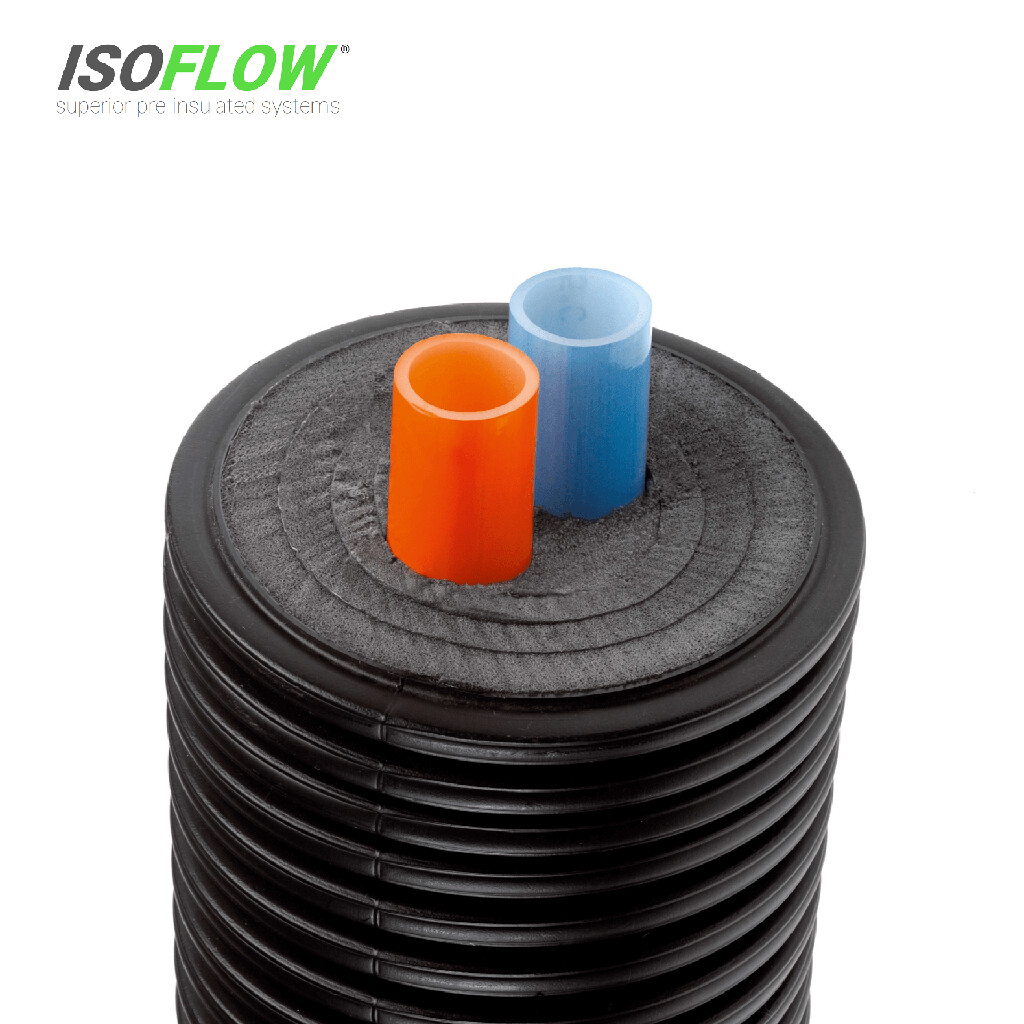
That pipe can be expensive…
Are you planning on having stored hot water in the Outbuilding?
(Sorry for all the questions, but your answers will help me understand how similar your situation is to mine.)
David
Hi David,
Mines an F1245
The heat loss for the building is less than 1500w according to calcs.
a constant 21 deg, but will turn it off when its not in use for long periods. The main house is 1930’s & I will look at the data over the last few years to give that info… yes been googling the pipe… £50 per m for the underground bit, but still significantly less than a separate heat source.
Hot water, yes… but the usage of hot water is normally summertime so I’m thinking immersion & use excess solar to heat that tank as a possibility.
Or make your own, hep2o pipe, insulation inside underground pipe or gutter downpipe. Well cheaper than £50/meter, and at least as good, can be way better
Thanks for the extra info. In my case I had roughly double that heat loss and wanted to be able to maintain about 16C then bump it up to 20C when I decided to spend time in the Outbuilding. That pointed me firmly in the direction of having a separate system, with an Air-to-Air unit delivering a comfortable temperature much more quickly than Air-to-Water (especially with UFH).
If you’re planning to maintain a steady temperature 24x7 that will be less demanding than my scenario, and 1,500W is clearly a modest fraction of the nominal 8kW output of the NIBE unit (which I find to be conservative).
If you’re happy to handle stored hot water with solar divert to an immersion (and/or instantaneous water heaters for ’top-up’) that removes the complication of trying to run a DHW cycle to a remote cylinder in the Outbuilding - especially since I believe your F1245 has an integrated DHW cylinder.
So I agree it could work but it depends on what priorities you assign to the various pros and cons.
Given an extra 60-70m of pipework (plus whatever is in the Outbuilding itself) I think you’d be hard pressed to avoid a supplementary circulation pump. Maybe if you go for large-diameter pipes you’d get away with it being part of a single zone with the House, like Johnmo described.
Having a supplementary circulation pump would allow for a degree of separate control, e.g. if the Outbuilding is better insulated than your 1930s house - but then you’d want some sort of ‘hydraulic separation’ (to prevent the Outbuilding stealing all the flow, leaving too little for the House) unless you already have a three- or four-pipe Buffer tank or similar?
It’s worth bearing in mind that a 2.5kW (9,000BTU) split-system ‘air conditioner’ would be roughly £500 + installation and could provide cooling as well as heating.
David
Thing I have found heating our outside room
The heat loss degrees per hour is a lot different from the house, so heating can be difficult if you want to heat to a steady temperature - unless you run as desperate zone and accept some heat pump cycling. We allow our room to fluctuate a fair bit and use it as background heating to stop the building getting too cold. If we want a steady temp we switch on an electric heater knowing we only have to heat a few degs and we don’t use the room that much.