This note is aimed at prospective heat pump owners, and is intended to bring together the relevant information from a number of discussion threads. My apologies to seasoned heat pump owners for the repetition.
You might be considering a wireless room thermostat (aka roomstat) if the wired roomstat installed with your heat pump will not be in the ideal location for temperature control of critical rooms (e.g. living room) and cabling of a wired thermostat is not practical (or if you want to be able to easily relocate the roomstat from time to time).
Wireless roomstats come with different levels of smartness (for example the more sophisticated – thus expensive – ones can automatically vary programme timing and temperature setpoints according to “learned” user preferences, and some even accommodate varying tariffs), but in most cases they apply the same basic control principle – TPI (time proportional/integral).
Unlike electro-mechanical thermostats which have a built-in hysteresis (i.e. the temperature range between “off” and “on”), these control by changing the duration times of “off” and “on”. (In other words, wired thermostats offer amplitude modulation, whereas wireless thermostats offer frequency modulation.)
In wireless roomstats, a cycle is a fixed period of time that includes an “on” period and an “off” period, but where the relative durations of “on” and “off” vary. These proportions are calculated and continuously updated by the thermostat software. It does this by sampling the rate of room temperature change when “off” (due to heat loss from the room) and “on” (due to the surplus of heat from the emitters over room heat loss), and, applying in-built TPI factors for setpoint departure and rate-of-approach, calculates the new ratio of “on” to “off” time needed for the next cycle. A time plot illustrating this is included below.
In any wireless roomstat, the user can typically set the desired cycle rate (may be in factory settings) depending upon the application. For example the Honeywell T3R (a fairly basic wireless roomstat) allows a cycle rate selection of 1,3,6,9 or 12 per hour. Gas boilers would operate without problems at the higher cycle rates, but heat pumps would definitely not (heat pump stop/starts should not exceed 2-3 per hour, to minimise mechanical wear in the compressor).
In addition to cycle rate selection, wireless roomstats may allow the setting of minimum “on” or “off” times to give time for the controlled device to react to changes. Gas boilers will tolerate rapid switching, but heat pumps do not, and any minimum “on” or “off” times available should be maximised.
Wireless roomstats provide exceptionally (arguably unnecessarily) stable room temperatures even at just 1 cycle per hour, but at the cost of inducing more frequent heat pump cycling than a wired thermostat would. (Several wired thermostats offer adjustable hysteresis. This allows users to optimise comfort – small room temperature swings – against compressor longevity – minimised cycling.)
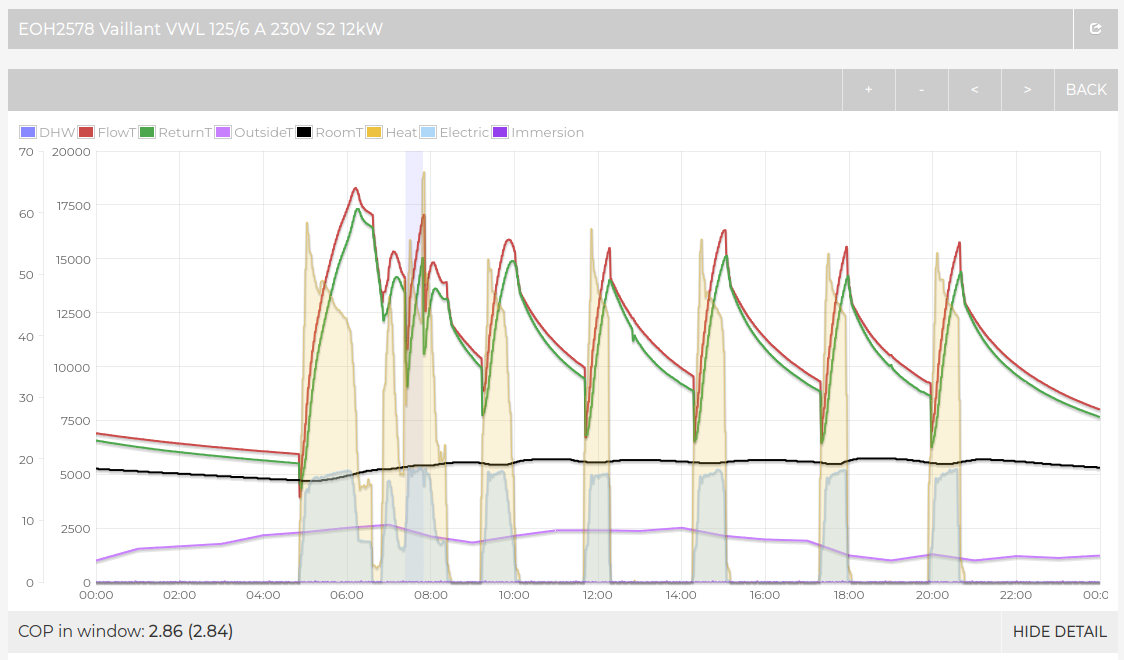
To illustrate the performance of a wireless roomstat and its effect on the heat pump over a 4-hour period, here is a recent plot which is worth a brief study. In this example, the cycle rate set in the roomstat (a Honeywell T3R) is 1 per hour.

On this plot, roomstat “on” and “off” is best indicated by the circulating pump flow (the black line). As you would expect, each cycle starts (about) 1 hour later than the previous one. For the cycle starting at 13:15, the T3R had calculated a mark-space ratio of about 0.6, and so switched “off” about 0.6 x 1 hour = 40 minutes later. For the next cycle, the T3R had recalculated the required mark-space ratio to be about 0.5, so shortened the “on” period appropriately. This same ratio was maintained – approximately – for the third cycle.
Unfortunately the T3R has a display precision of only 0.5degC so it was not possible to detect room temperature changes less than this, but throughout this whole period the T3R was displaying a room temperature of 21.5degC, the same as the setpoint (i.e. the room temperature did not vary by more than 0.25degC).
The conclusion is that cycle rates well below 1/hour would still provide an acceptably constant room temperature, but unfortunately such rates are not widely available in commercial wireless roomstats. If heat pump cycling at this frequency is unacceptable to you, you should avoid them in favour of wired thermostats, preferably ones with an adjustable hysteresis.
A few other points and observations:
- With a wireless roomstat, the heat pump controller does not have actual room temperature information – only a switched signal (demand or no demand). Most modern heat pumps can accept this, but some older ones may require a modulated signal directly from an instrument.
- The heat pump controller may be primarily designed for a hysteresis-based (wired) roomstat (which would normally provide a very low cycle frequency due to high room thermal inertia), and contain an algorithm that applies 2- or 3-term control to any switched (“on”/”off”) roomstat signal to manage room temperature overshoot and hysteresis. If the switched signal is more frequent than that designed for, the controller can behave unpredictably (e.g. switch off the heat pump before the roomstat target has been reached). This may be another reason to avoid wireless roomstats (or to ensure that if one is installed its cycle rate can be set to or below 2-3 per hour).
- On the above plot, it is the roomstat that is switching off the heat pump, not the weather compensator acting to limit LWT – the latter (red line) does not significantly exceed the target (yellow line), and the compressor speed (mauve line) remains above the minimum - 20Hz in this case. (If LWT exceeds target noticeably, the controller normally reduces compressor speed to minimum before switching it off.)
- If you do use a wireless roomstat to control space heating, you will need to set your heat pump controller to ignore any in-built wired roomstat.
- (Relevant to my particular arrangement only, and nothing to do with roomstats) Notice how the measured ambient temperature (the brown line) dips slightly every time the heat pump evaporator fan starts. This is due to cold air recirculation flowing over the ambient temperature sensor, and results in a discernable increase in weather compensator target temperature (yellow line). This may be out of your control, but a badly-located instrument can adversely affect the heat pump operation.