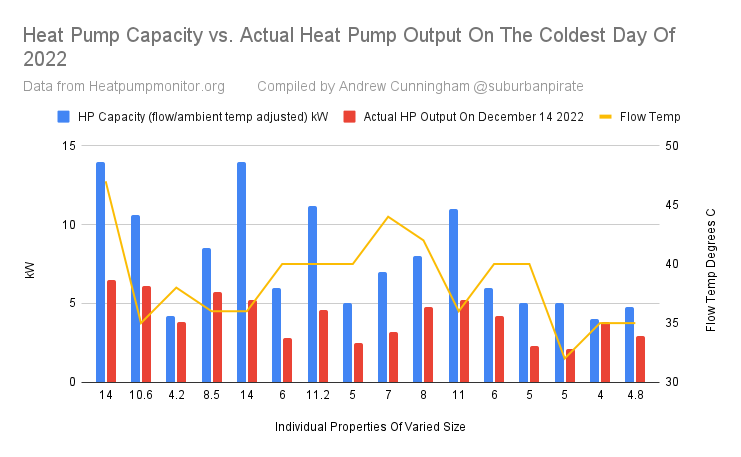
A slight tweak adding flow temps.
2 Likes
Hello Andrew, Ken, great to see you both on here! and thanks for posting this up here Andrew.
One question I have in my mind at the moment is what is the actual capacity of each heat pump during regular defrost conditions? I think it might be lower than some? manufacturers are stating on the datasheets, mostly going on the Daikin I mentioned, I may be wrong about this, It would be interesting to try and excercise next winter during near zero conditions to try and max out our heat pumps over a 4 hour period to see how close to datasheet output they can achieve? This is clearly not an issue for the Vaillants on there which have datasheet capacities above their badge.
Building on the earlier table above, I thought I would try finding the maximum output of each heat pump on the list over a 4 hour period where outside temperatures were below 1C. The script that I’ve put together to generate the following can easily be modified to change the period to e.g 2 hours, or filter for specific outside temperatures, so happy to re-run this with different parameters, here are the results:
| location | heatpump output | heatpump model | heat loss survey | heat demand | div 2.9 | Max output below 1C | Outside temp | % of heatpump output | % of heat loss |
|---|---|---|---|---|---|---|---|---|---|
| Oxford | 3.5 | Vaillant Arotherm+ | 3 | 7500 | 2.6 | 5.3 | -7.5 | 151% | 177% |
| Heat Geek Towers, Camberley | 5 | Vaillant Arotherm+ | 5 | 6000 | 2.1 | 5.2 | -2 | 104% | 104% |
| Sheffield | 5 | Vaillant Arotherm+ | 5.4 | 9000 | 3.1 | 5.0 | 0.5 | 100% | 93% |
| North Hertfordshire | 5 | Vaillant Arotherm+ | 6 | 8000 | 2.8 | 4.8 | -9 | 96% | 80% |
| Machynlleth, Wales | 6 | Mitsubishi Ecodan | 1.5 | 7500 | 2.6 | 5.7 | 0.5 | 95% | 380% |
| Cambridge | 8 | Samsung HTQ | 7.8 | 10897 | 3.8 | 7.0 | -2.5 | 88% | 90% |
| Fife, Scotland | 7 | Vaillant Arotherm+ | 0 | 23500 | 8.1 | 6.1 | -7.5 | 87% | |
| Stratford-upon-Avon | 7 | Vaillant Arotherm+ | 7.57 | 7300 | 2.5 | 6.0 | -2 | 86% | 79% |
| Banbury | 7 | Vaillant Arotherm+ | 6.5 | 0 | 0 | 6.0 | -2 | 86% | 92% |
| Llanberis, Gwynedd | 5 | Samsung Gen 6 | 3.5 | 8000 | 2.8 | 4.1 | -1 | 82% | 117% |
| St Albans | 5 | Vaillant Arotherm+ | 4.1 | 9143 | 3.2 | 4.1 | 0.5 | 82% | 100% |
| Nottingham | 12 | Midea | 8 | 11332 | 3.9 | 9.8 | -0.5 | 82% | 123% |
| Basingstoke | 10.6 | Daikin 11kw monobloc | 9.8 | 21000 | 7.2 | 8.1 | 0.5 | 76% | 82% |
| West Yorkshire Peak District | 8.5 | Mitsubishi Ecodan | 8 | 15452 | 5.3 | 6.3 | -1.5 | 74% | 79% |
| Malton, North Yorkshire | 14 | Mitsubishi Ecodan | 14 | 41699 | 14.4 | 10.3 | -4 | 74% | 74% |
| Gloucestershire | 5 | Mitsubishi Ecodan | 3.5 | 7200 | 2.5 | 3.6 | 0.5 | 72% | 103% |
| Weston-super-Mare | 7 | Daikin EDLQ07CV3 | 0 | 9524 | 3.3 | 5.0 | -1 | 71% | |
| Llanberis, Gwynedd | 5 | Mitsubishi Ecodan | 4.5 | 8000 | 2.8 | 3.3 | -3.5 | 66% | 73% |
| Manchester | 6 | NIBE F2040-6 | 3.5 | 7000 | 2.4 | 3.8 | -4 | 63% | 109% |
| Weymouth | 14 | Mitsubishi Zubadan | 0 | 27328 | 9.4 | 8.8 | 0 | 63% | |
| Manchester | 5 | Mitsubishi Ecodan | 3.4 | 9500 | 3.3 | 3.1 | -0.5 | 62% | 91% |
| North Yorkshire | 6 | Grant Aerona3 | 6.25 | 15500 | 5.3 | 3.7 | -5 | 62% | 59% |
| Banbury | 8.2 | Vaillant Arotherm+ | 7.6 | 0 | 0 | 4.8 | 0.5 | 59% | 63% |
| North Yorkshire | 11 | Mitsubishi Ecodan | 9.4 | 22000 | 7.6 | 6.3 | -2 | 57% | 67% |
| Kidderminster | 7 | Acond PRO-N | 37 | 6570 | 2.3 | 3.9 | -1.5 | 56% | 11% |
| Bangor, Wales | 11 | Mitsubishi Ecodan | 5.5 | 11000 | 3.8 | 6.0 | 0.5 | 55% | 109% |
| Newbury | 14 | Mitsubishi Ecodan | 11.5 | 12000 | 4.1 | 7.5 | -2.5 | 54% | 65% |
| Sheffield | 11.2 | Mitsubishi Ecodan | 9.989 | 23594 | 8.1 | 5.8 | -1 | 52% | 58% |
| Derby | 8 | NIBE F1145 | 0 | 4542 | 1.6 | 4.1 | -1.5 | 51% | |
| Sofia, Bulgaria | 8 | Atlantic Alfea Extensa | 5 | 12800 | 4.4 | 4.1 | -8 | 51% | 82% |
| Swansea | 11.2 | Mitsubishi Ecodan | 0 | 30000 | 10.3 | 5.4 | 0.5 | 48% | |
| Fleet, Hampshire | 12.12 | Daikin Altherma | 0 | 12700 | 4.4 | 4.5 | 0 | 37% |
Plot of max heat output over 4 hour period as a proportion of badge capacity (outside temp below 1C)

I should overlay this with the max heat output over a 24 hour period to see how it changes…
3 Likes
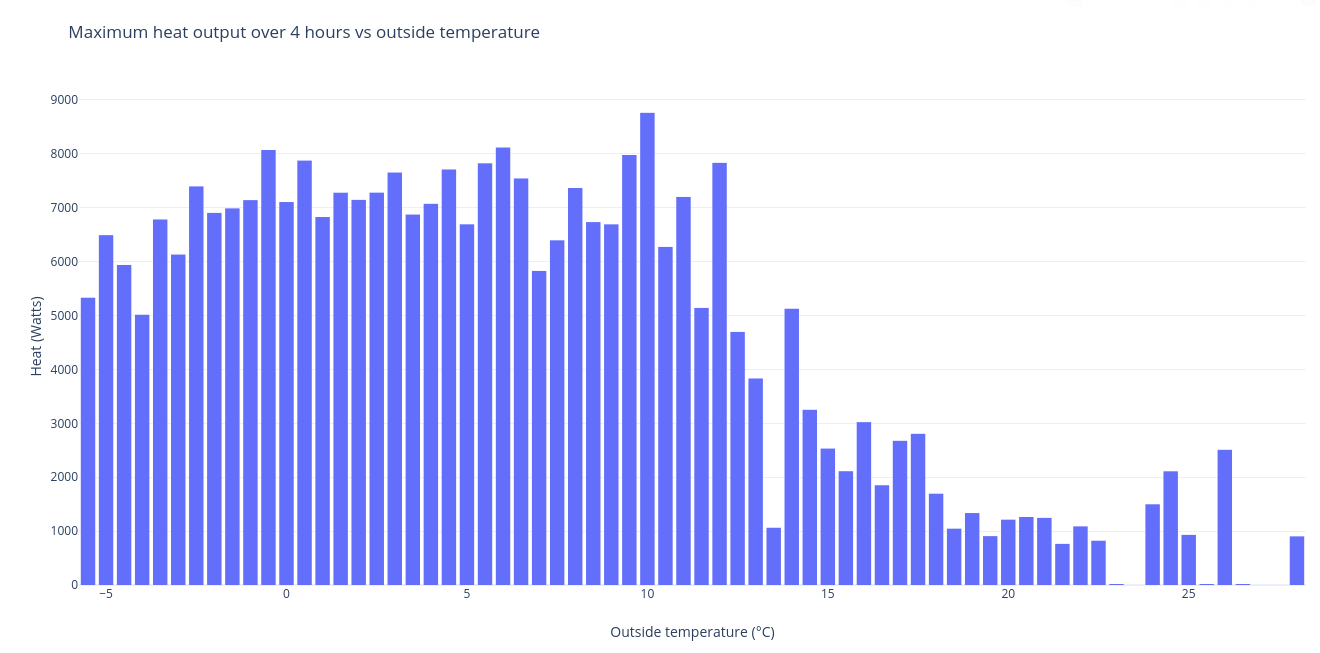
I also extracted the maximum, attempted so far? heat output over a temperature range for a number of the heat pumps on the list.
My Ecodan, 5kW:
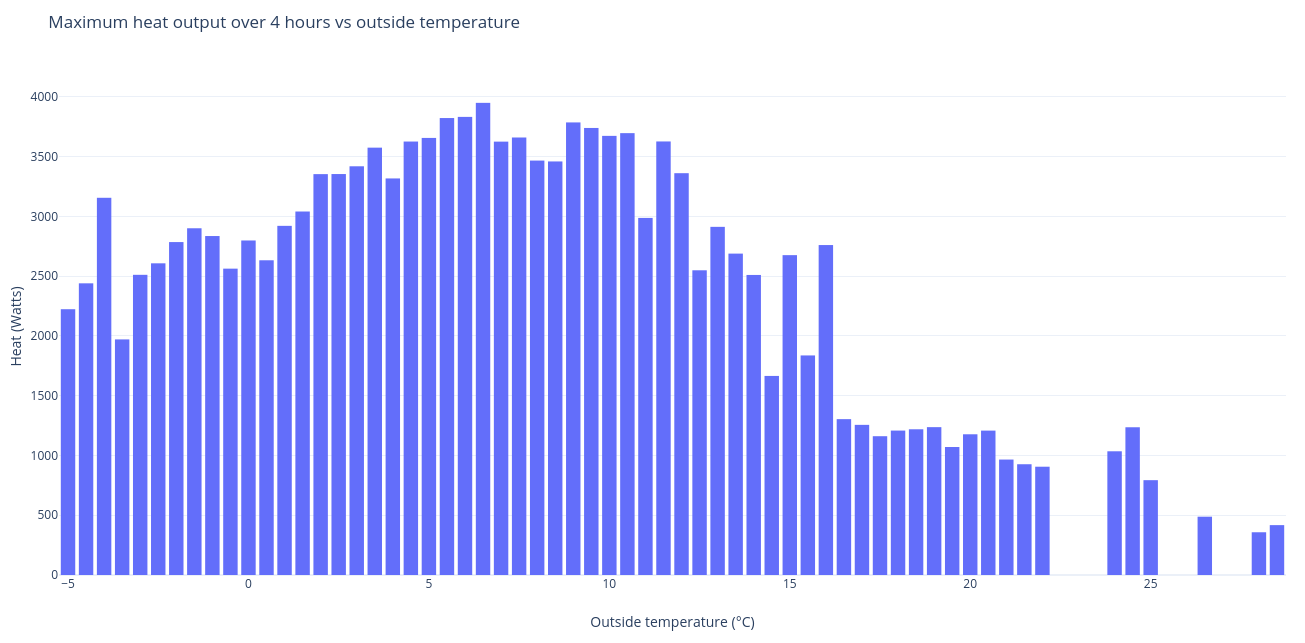
Here’s @glyn.hudson’s samsung 5kW:
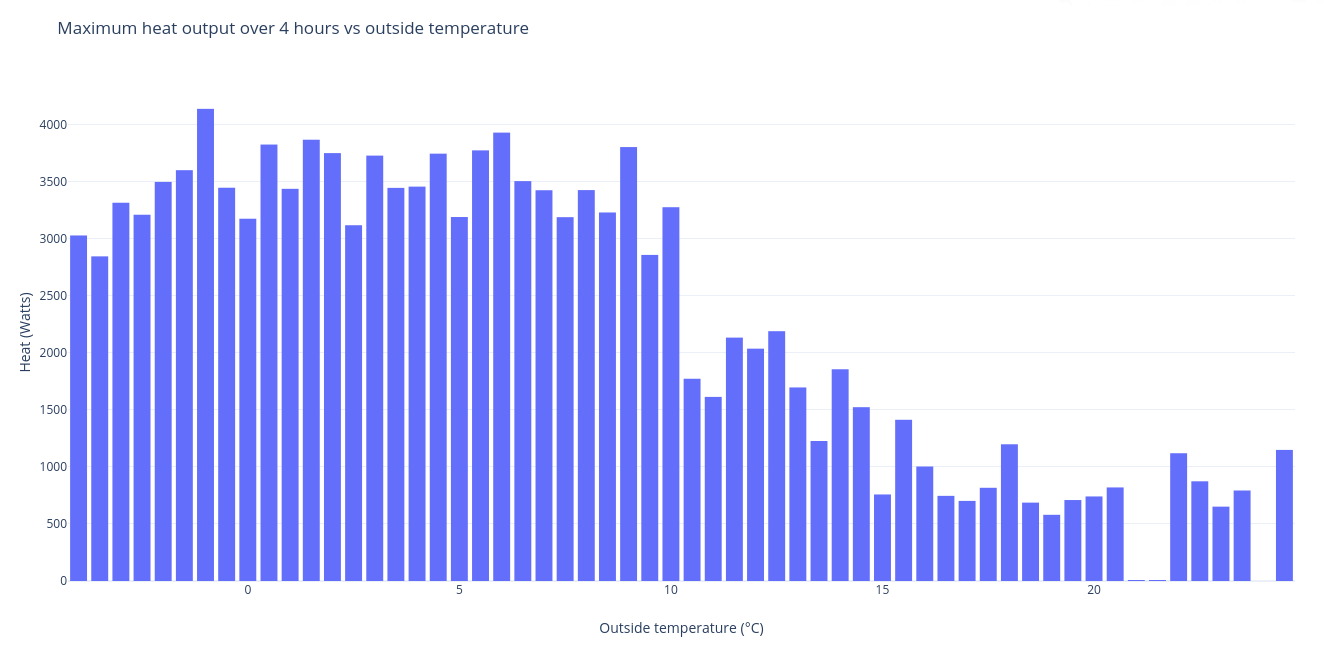
Yorkshire, Ecodan, 11kW:
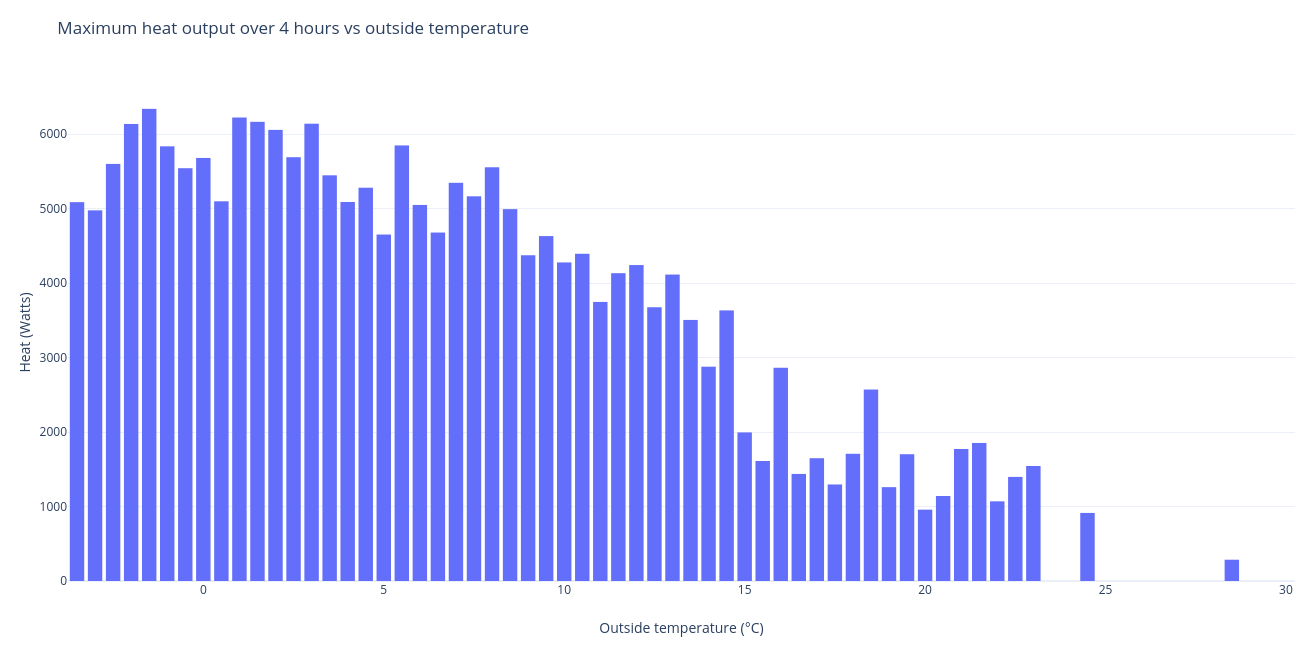
Manchester, Nibe, 6kW:
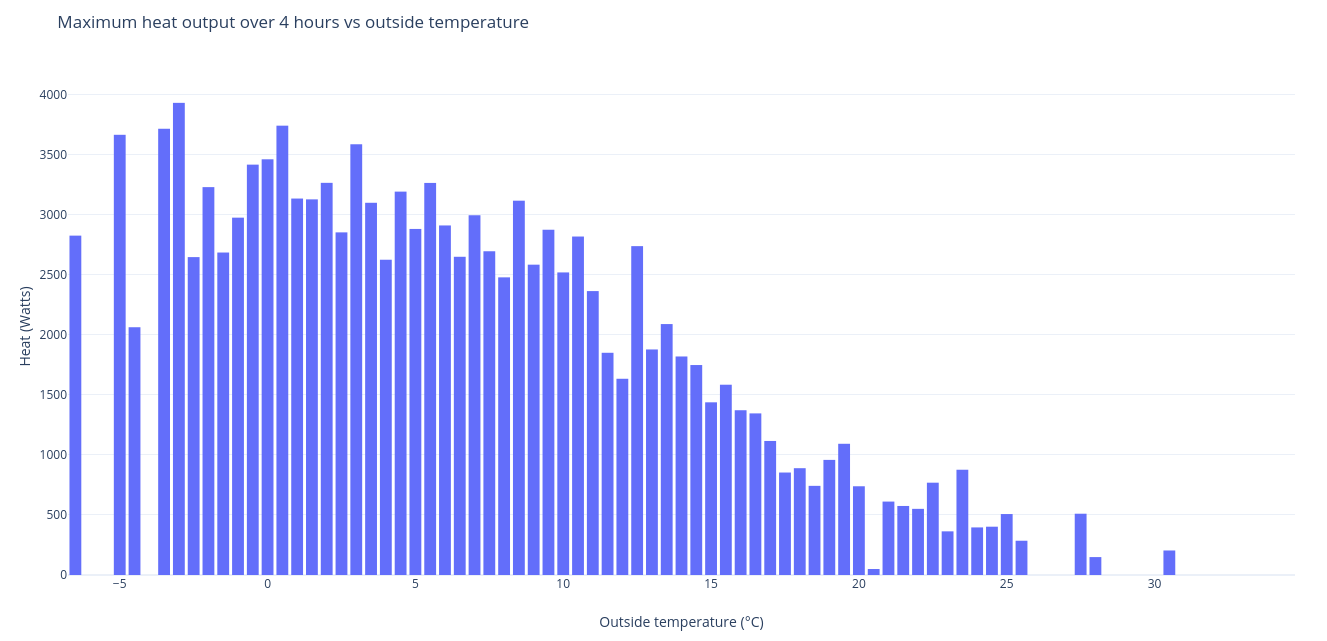
Heat Geek, vaillant, 5kW:
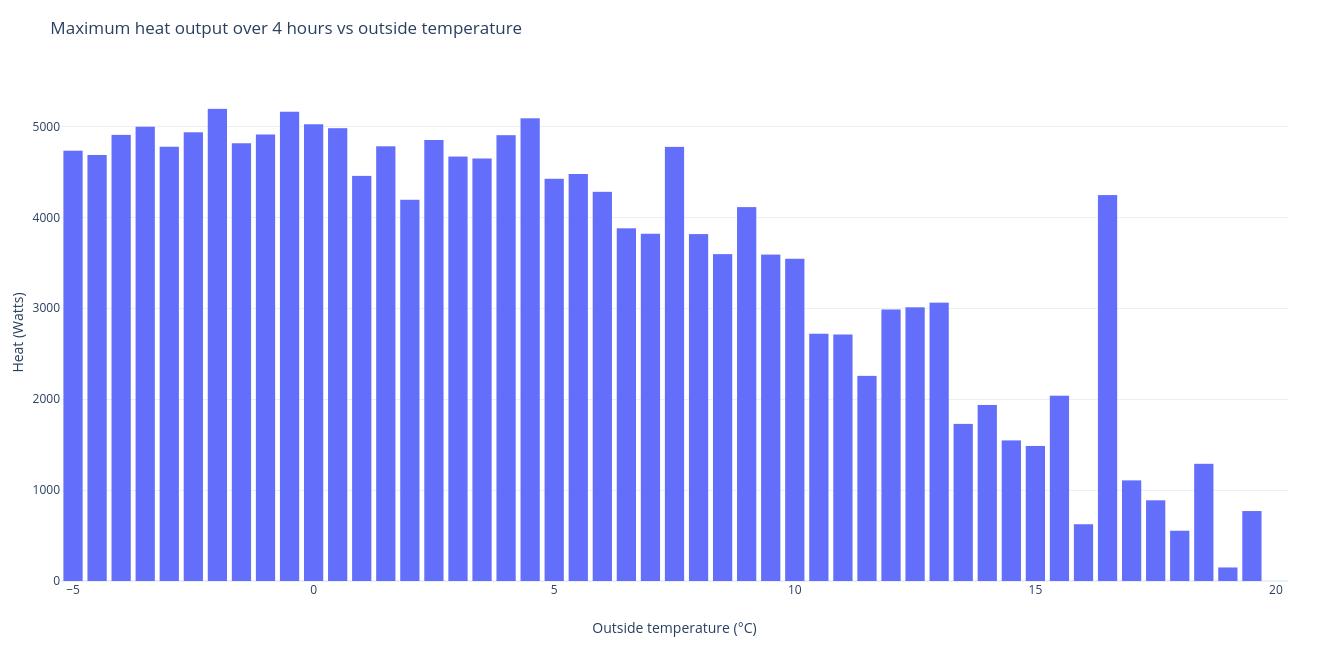
Daikin 11kW (This is the one I know is struggling to do much above 7.5-8 kW below zero), heat loss of the house is 9.8 kW based on previous years 24h gas use.
1 Like
Brilliant stuff Trystan.
Interesting to see how some are clearly not producing as much heat as you might expect at low temps.
The Daikin 11KW clearly maxes out at about 0C.
I wonder how defrosts are affecting temps? Also maybe a WC curve too low? As you say it’s hard to know if the heat pumps could have done more.
Room temps is something I would have added which would be a measure of ‘customer satisfaction’ but I found limited data on that. Maybe you could overlay room temp data?
I would say the value of these comparisons would be to see at a glance how likely it is for a heat pump install to keep you warm in winter but at the same time the chances of being hugely oversized.
Andrew
1 Like
Thanks Andrew,
Yes agreed, I will definitely try a number of max output tests next winter 
Some folk are monitoring room temp, so including that for those that have it should be possible.
Perhaps also a drop down selector in the form? to gauge perception of comfort and capacity of heat pump to reach higher temps? Given that people have such different comfort levels?
Agreed that customer satisfaction is probably more important than exact room temps achieved.
People will have such different needs.
Some will really want and need at least 21 C all day and night.
While others might relish putting on 2 jerseys at 17C and toughing it out.
Also some properties might be packed with people and cooking and computers.
Hello
Hi Ken
Im interested in your take on this.
Andrew
As long as the refrigerant remains and the compressor has had a good life, ( ie not short cycling, or High pressure issues due to poor heating design ) then should be good for over 20 years.
My current Samsung is already 12 years old and second hand.