I’ve never heard of this, I can’t see any reason why this would the case? Unless the evaporator or fan gets dirty, but it can easily be cleaned.
It’s useful to have a bit of capacity in reserve, to account for the occasions when you need to re-heat the house when it’s cold e.g coming back from holiday. In this case you need to input more heat than you would normally need to maintain the temperature. I’ve managed to get 85kWh of heat from my 5kW heat pump re-heating my house when the outside temperature was below 0C, this is way more than I need to maintain the temperature. But if you have a wood stove you probably don’t need to worry too much about this.
I don’t think this is always the case, in general higher rated heat pumps are noisier than lower rated heat pumps e.g my 5kW Gen6 Samsung is nice and quiet, but larger Samsung Gen6 heat pumps have a reputation for being noisy. However, the noise of the heat pump is proportional to flow temperature, there’s a good chance that people who have issues with a noisy heat pump is because it’s running at a high flow temperature. I think the quietest heatpump is the Vaillant Aerotherm+, although the new Samsung HTQ is supposedly pretty quiet. Quieter heatpumps tend to be larger physically since the larger the fan the quieter the noise. My outdoor unit is wall-mounted so having a compact unit was a big plus.
This is totally understandable, a cold customer is not a happy customer! However, I think this is the main reason that heatpumps are commissioned to run a higher than needed flow temperature. The over sizing of the heatpump is maybe due to incorrect assumptions made during the heatloss calculation, or not doing a heatloss calculation at all and sizing the heatpump based on EPC data, this is actually pretty common! 
The single thing which has the greatest effect on heat pump performance is flow temperature, if you want to maximise SCOP the focus should be on getting the flow temperature as low as possible, ideally under 40C at design temperature. Getting a low temperature will probably require radiator and possibly pipework upgrades but will be worthwhile long term.
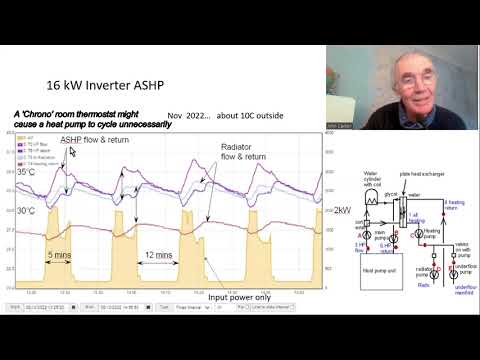
From my experience and looking at monitoring data, flow temperature and control strategy has a much greater effect on performance than heat pump than sizing and cycling. I can think of examples where an oversized heatpump can get good performance even while cycling because it’s running at a low flow temperate with optimised control setup.
@johncantor has made a good video on the topic of heatpump cycling