Another imperfect but hopefully useful test of the inbuilt Grant metering system, this time looking at flow and return temperature sensors.
Aim
I wanted to determine whether the flow and return values reported by a Grant 9kW HP290 were accurate, or at least internally consistent, since this could be affecting the calculated COP.
Method
I used the EcoNext Home Assistant integration to record the flow and return temperatures reported by the Grant unit.
I used a Sonoff Zigbee temperature probe to monitor the flow temperature on the radiator circuit. The probe was placed lengthways along the main flow pipe, underneath 13mm foam insulation which was sealed with tape.
When the Grant heat pump is on standby, the primary circulation pump and radiator circulation pump continue to run. This should lead to uniform water temperature throughout the primary pipework and radiator circuit. Two time-series were collected, one when the heat pump had been in standby for several hours, and one where the water was cooling down following a heating cycle.
Results
Reported below are the flow, return and circuit temperatures for the standby experiment, and also the calculated difference between flow and return:
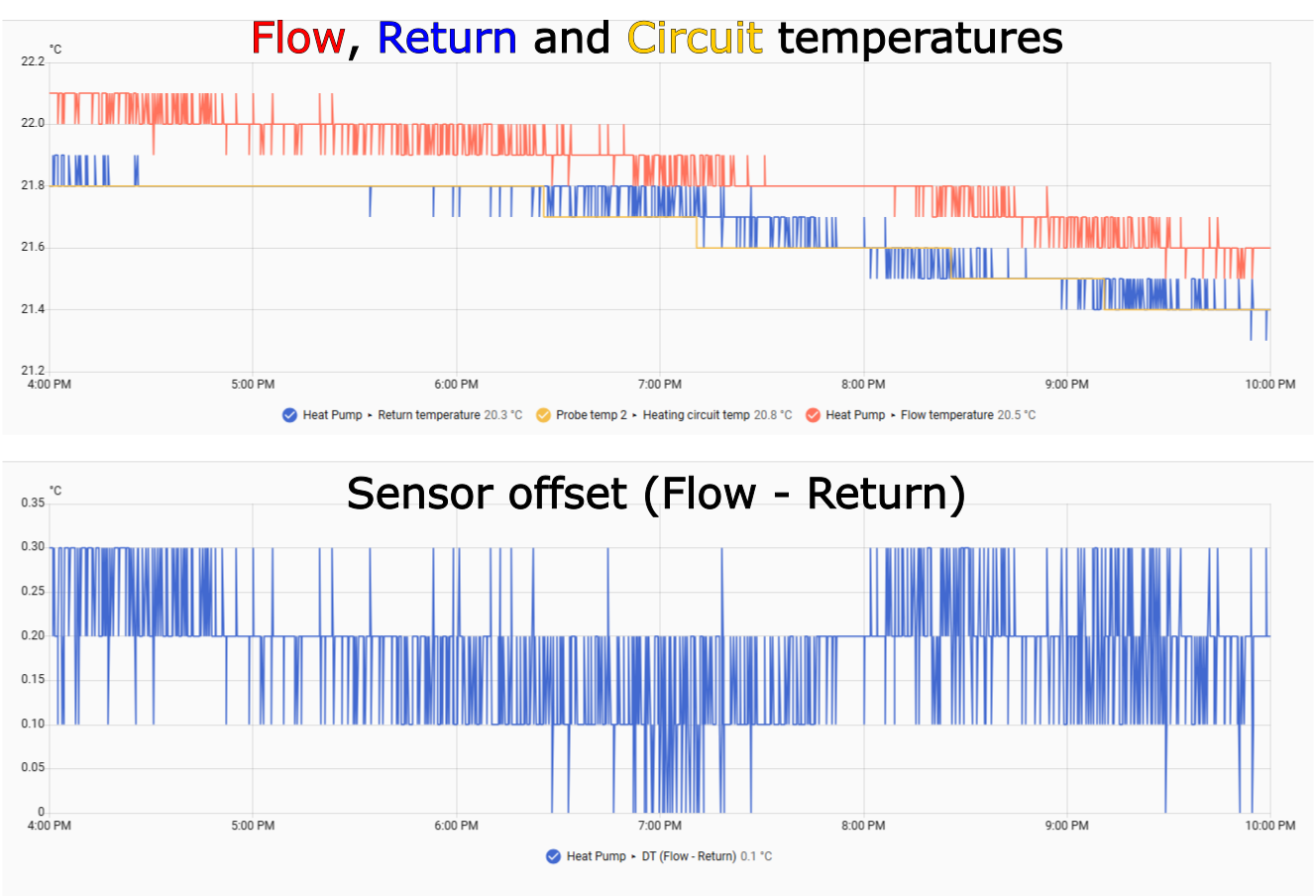
Temperatures dropped gradually during the experiment, since the heating water was losing energy during the round trip to the outdoor unit. The radiator circuit temperature agreed closely with the return temperature, but flow temperature was 0.18 ± 0.08 °C higher than return.
When the experiment was repeated following a heating cycle, the temperatures started higher and cooled back towards the stable internal temperature of 21 °C.
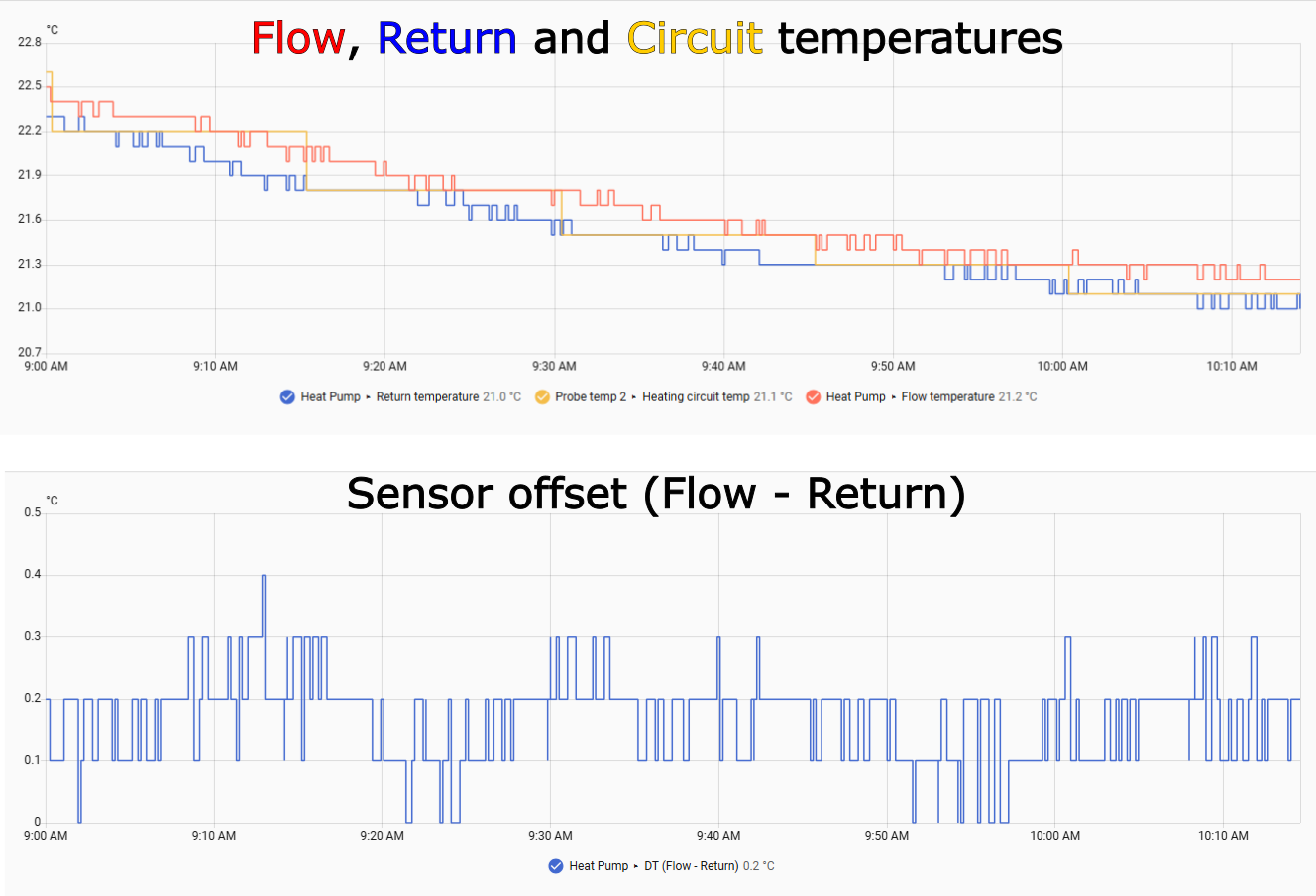
Once again, the reported flow temperature was 0.1 - 0.2 °C higher than the return, and the radiator circuit probe tended to agree with the return temperature.
Findings
I can’t independently calibrate any of these sensors, so the findings are all relative. However, data from the Sonoff probe on the radiator circuit suggests that the accuracy is reasonable.
It seems that the flow temperature sensor is not perfectly paired to the return sensor, it is consistently reporting values that are 0.18 °C higher. These results are slightly better than those from Glyn’s data above, where the dT reported by the heat pump was 0.34 °C greater than that measured by the heat meter.
Small offsets like this seem quite good when compared to some of the reports from the corresponding Vaillant thread, where differences of 0.9 °C or more are reported (e.g. Vaillant inbuilt monitoring vs MID meters - #194 by CH_18 ).
Effect on COP
My reported dT is higher than reality by 0.18 °C, which I believe will lead to over-estimates of thermal output and COP of 4 - 8% depending on the actual dT during operation (reported dTs are ~5 °C during a DHW run, ~2.5°C during a heating cycle at the moment).
From the posts above, it seems that flow rate and specific heat estimates from my Grant HP290 are likely to be larger sources of COP uncertainty than the temperature sensors or electrical power.