Hi, Can anyone shed any light as to what the real world outputs are on the 4, 6.5 and 9KW Grant R290 heat pumps when in a -3 winters day? Are they performing to the badge or falling a little short. I have a job at present with 4.26KW heat loss at -2.1 and I am thinking possibly a 5KW Vaillant is better suited to the job in hand unless the 6.5KW Grant unit is not performing as a 6.5KW unit when it gets cold. Please be kind as it’s my first post! Thanks John
You can find results of some maximum output testing by community owners here → HeatpumpMonitor.org
I seem to recall that Grant have better modulation than many other heatpumps.
The new version (2026 v2) Vaillant (e.g.“5kW” model number VWL 55/8.1 A ) have improved minimum modulation specs according to the datasheet:
A7W55: min 0.96, max 7.93 kW
A7W45: min 1.25, max 8.23 kW
A7W35: min 1.57, max 7.20 kW
A2W55: min 1.57, max 6.24 kW
A2W45: min 1.65, max 6.29 kW
A2W35: min 1.89, max 6.28 kW
… although too new to get real world figures of course including defrost cycles.
Also worth saying that depending on the property type, when you get down to low heat losses like 4 kW and below, “incidental gains” can become significant e.g. body heat (100 W per occupant), domestic fridges (30 to 70 W daily average), misc electronics “base load” (50 W not uncommon), DHW standing losses, cooking (~ 50 W daily average), and could easily net at least 300W (for our family of 4 it’s more like 600 W).
Probably one for the Vaillant thread, but do you have a link to the datasheet?
If we assume cheap overnight electricity will continue, should we design based on using a simple electronic immersion for DHW on the coldest days of the year to reduce defrost cycles?
This would allow some homes to have lower capacity heatpumps and maybe lower flow temperatures as the heatpump is heating 24/7 rather than stopping CH to do DHW.
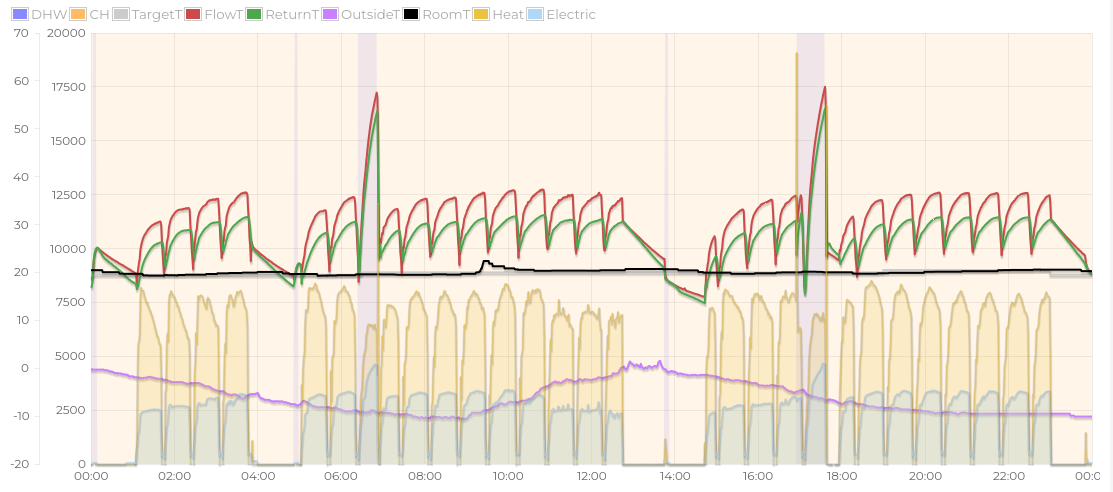
Based on cheap period of electric, I only heat via immersion now 365 days a year via a normal immersion timer. In summer it allows cooling to run without being interrupted by having to do DHW.
During winter I can utilise cheap cosy slots for heating and DHW and get a full 8 hours of heating if I want with in cheap rate periods
Cost wise it hasn’t made any real noticeable difference doing DHW via immersion.
Would suspect a low heat capacity house or poorly insulated would benefit from this approach also, as on cold days there is less time spent away from doing heating duty.
I certainly noticed hot water heating taking around an hour summer and winter when I had my 6kW heat pump, if you’re heating twice per day that’s a fair chunk of the day not heating the house when you add defrosting in also.
The climate does not thank you for using an immersion heater.
Is everything always about money?
Agreed, the immersion strategy just doesn’t make sense to me. It’ll always consume, and cost, 3-4x the energy of just using the ASHP to reheat.
Most efficient approach is sizing your DHW tank to cope with mostly needing to reheat only once per day, in the off-peak window. Continuous cooling is generally not as necessary overnight, and an hour or two break in heating is also fine when everyone’s asleep.
We run our ASHP like this, it’s never compromised comfort during the heating or cooling seasons, and costs peanuts to run. Never used the immersion. Our 250-litre tank suffices with a single overnight reheat per day to 50C for our family of 4. I increase the DHW setpoint to 60C when we have guests, and can always manually boost the DHW ad-hoc if required.
A bit of a rewrite from my original post.
Why does the climate not thank me for using an immersion - it’s always in a cheap period which also generally a period of low demand and excess spinning reserve in the grid. During my day time heat, I am also producing my own electric via PV most days.
Is everything always about money? - I am using the heating and immersion to get best overall efficiency for my house, using each appliance to its best advantage, running costs comes into that, the immersion costs me more that heating with an ASHP but the difference is surprisingly small. Not really chasing best SCoP by running everything via the heat pump. Best SCoP doesn’t mean it’s efficient or effective always especially for the environment, so generalisation isn’t helpful.
But currently running the heat pump to charge the floor from solar (which will be used later when it drops to 2 degs) and the DHW will also be heated via immersion at the same time, both are not using any grid electric while doing so - all from excess solar, currently export price isn’t great so the grid not in need of my excess.
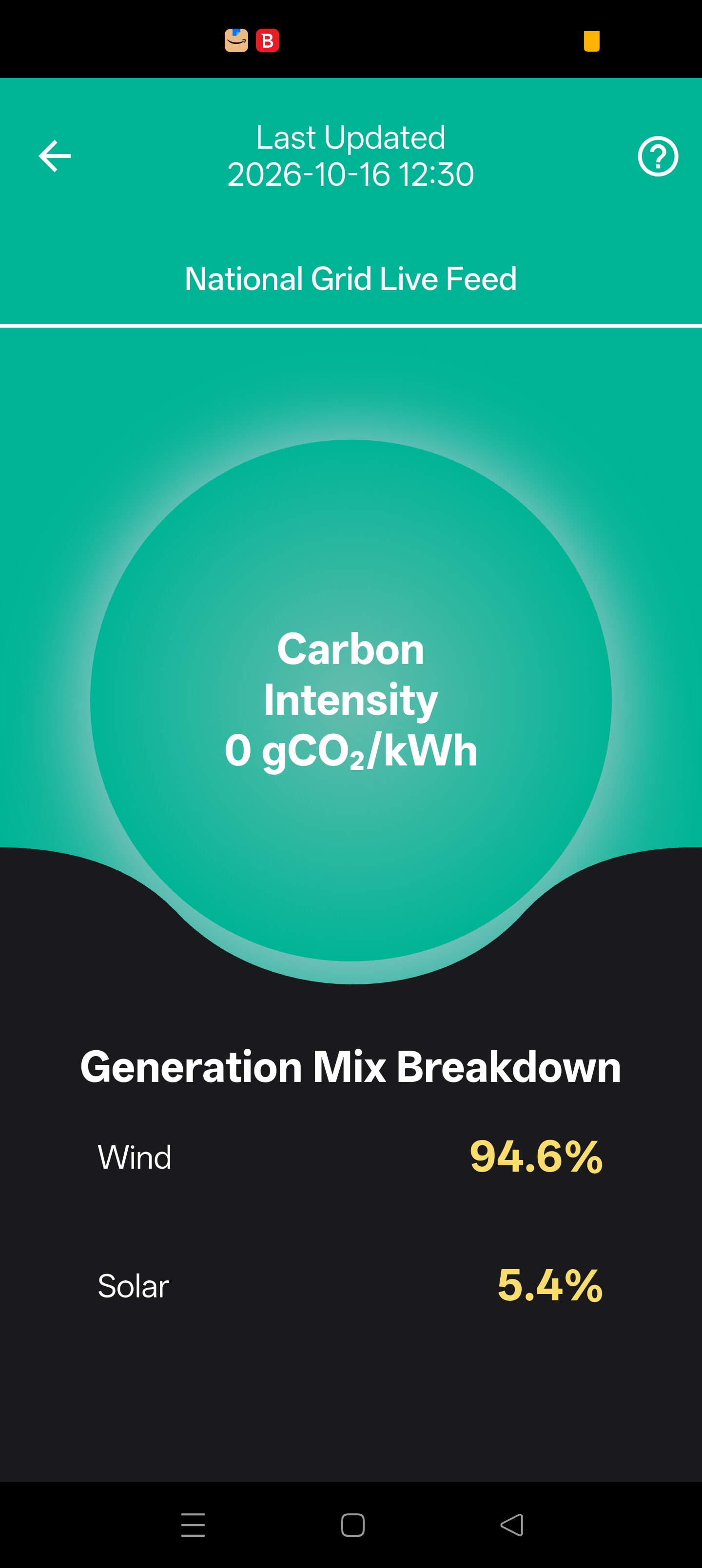
Our current grid mix is attached. So zero harm is being done to environment.
It is quite likely to not continue, and we’re already seeing shifts in wholesale prices such that nighttime is no longer the cheapest part of the day.

Am I reading correctly that some people are reporting modulation on the 6.5KW heat pumps down to just over 1KW when Grant have a stated minimum modulation of something like 2.5KW?
You could be completely forgiven for thinking that but electricity generation system has evolved faster than even Octopus anticipated. On average, across the whole year, electricity is now cheapest during the day (because solar). Mick Wall made a video about this. (Edit: as already posted by Tim!) I spotted the change using his data:

I am still on Cosy for import so my payment slots are predefined, my exports are on agile, so a moving target.
But being in Scotland it’s a rare day when most or all of the electric isn’t renewable any time if the day. So zero harm done by direct heating.
A quick look back in time - last similar day to yesterday I heated the cylinder twice using ASHP and used 4kWh of electric, with a report CoP was 3.65 for water heating. Immersion heating yesterday I used a similar amount of energy, some days I may use 5kWh. Our life style hasn’t changed, neither has the electric usage.
We have long pipe runs and although heat pump says all is great, it isn’t really. The efficiency of the immersion maybe 100% but it’s 100% efficient direct to cylinder water. No cold slugs of water to heat which also cool the cylinder. We also run our -cylinder hotter all the time 57 compared to 47 degs. Wife is happier also as she likes really hot water for washing up - bottom line is, happy wife, must be doing the right thing.
This equates to 14.6 kWh of heat delivered into the cylinder (minus some losses), which is not comparable to 5 kWh of immersion heating.
Finding equivalent DHW cycles is tricky because the state inside the tank is unknown. Best to look for days that have same delivered heat with same target temperature and same outdoor temperature (though latter is moot for immersion). Then compare the cost of heating that water.
ASHP will always beat immersion on efficiency and cost, but maybe that’s not significant to the overall energy bill, or there are other reasons for choosing immersion.
Yes 14.6kWh of heat delivered by ASHP. But even so since late last year my average electric input has been similar to the electric supplied to the heat pump when looking at DHW alone. So it’s not one day or a couple of days it’s most of a year.
But some basic maths says to use 7ish kWh X2 (2 heating sessions) you are heating 210L from a start temp of 17 (whole cylinder) and final temp of 47. Which isn’t reality, as the temp probe is 1/3 up and the thermocline would be just above there to initiate a water heat. So reality is you are only heating half that volume of water at each heat, so total kWh of heat energy is about 7kWh maybe a little less. So although a reported CoP of 3.6 ISH, really that should read maybe 1.8 or worse.
As I have said before the added advantages of immersion heating is
- I can heat or cool house AND heat DHW in the same time window, that can cheap rate electric (or poor export rate) from excess PV or ToU cheap slot.
- It really isn’t costing much more in electric consumption what ever the source.
- It’s simple and fully separated from ASHP.
- Doing it from scratch can be cheaper in upfront expenses.
Where is the other 7 kWh of heat going, if not into the tank? Transmission losses are unlikely to be that high, so it must heating the whole tank, regardless of where the temperature probe is positioned.
Suspect a cold slug of water hits the cylinder kills the thermocline (as taps run much cooler when an ASHP heat cycle starts). We generally have a large heat in the afternoon and a top up over night by a couple of degs.
Have just found this photo taken just before a water heat. At one point had 4 temperature probes up the side of the cylinder touching cylinder wall) to try and understand what was happening, as you can see we were only heating some of the water from about 20 degs and the very top about 7 degs. .
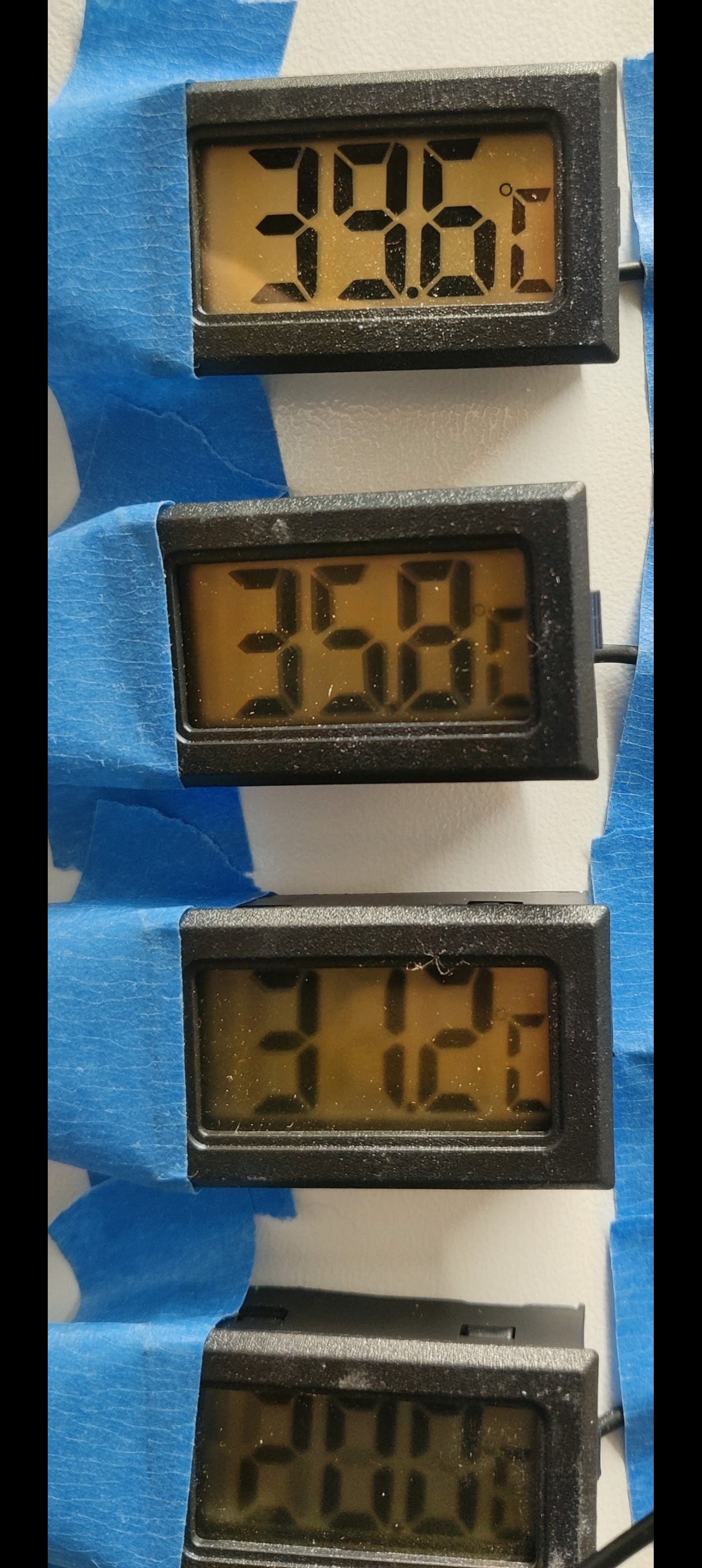
Bottom probe aligns with bottom sensor pocket about 1/3 up, the other probes are equally spaced up the balance of the cylinder (slimline 210L). So heat input in this case if we assume 2/3 is heating from 31.65 (average temperature) to 47 degs, is 2.5kWh. Then assume the bottom 1/3 is heated from 6 degs to 47 and that is another 3.2kWh, so that 5.7kWh, so likely to the worst case.
This is a reheat the other day, starting temp with a probe in exactly the same place as above but recorded in home assistant with start temp at 22.8 and in this case final cylinder temp at 56.8kWh, not 47 degs as in the case if the ASHP. The reheat takes 1 hour and 10 mins using a 3kW immersion. So a little over 3kWh. Next heating period is over night and the immersion runs another 30 mins, so about 4.5kWh in total to get cylinder back up to temp.

So based on the numbers I will stay as I am.
ASHP can have lower efficiency if the pipe from the ASHP is long enough compared to size of DHW tank.