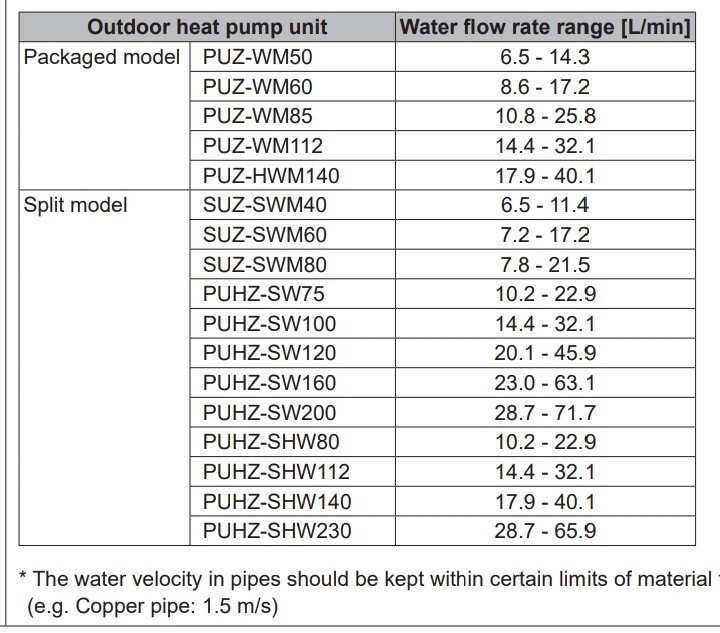
I recently setup the aswesome ESP integration for my Ecodan and noticed that it does use a lot of “Frost Protection” when its around 5 degrees outside. I have a Monobock (i e water to the outdoor unit), the pipes are insulated and no glycol in my water loop. I guess turning off the frost protection is probably stupid. But I seldom have minus degrees where I live, feels like a waste? I Have it set to speed 4 for heating and speed 5 for hot water. I can see that it uses 33w it speed 4 and 55w in speed 5. I have small dimensions on my piping so speed 4 gives 9l/m and speed 5 about 10l/m. Its a bit little for my machine actually but it seems to work, the circulation pump is noisy so i dont want it on speed 5 all the time.
I’ve split this into a new topic. Original is linked above.
The freeze stat mode is essential for protecting the outside unit from freezing, so long as it always has power. You can select a lower threshold in the settings, if you’re certain that the outside temperature sensor is sufficiently accurate. According to the FTC 6 manual, default setting for this is 5°C, minimum is 3°.
Running the main pump at a lower speed is an option, but does limit the amount of heat that can be delivered into the property. Also be aware of the minimum flow rates for your model.
Hi Karl, my Ecodan also uses a lot of pump power in frost protection mode. if you are feeling brave, you could take control of your pump speed using a pulse width modulation signal generated by a Raspberry Pi for example.
I have a low-loss-header in my system, with a Grundfos UPM GEO in the heat pump to LLH loop. I used to have a Grundfos UPM3 AUTOL in the loop from the LLH to the radiators. This pump could be manually set to one of about 10 control curves, but I wanted more control. So I replaced it with a Grundfos UPM3 FLEX AS, which is PWM controlled (it defaults to max power if the signal cable detaches or breaks). My main motivation was to control the radiator pump speed in heating mode so that the flow in the radiator loop exactly matched the flow in the HP loop, to avoid any loss of efficiency due to mixing loss in the LLH. But I also took the opportunity to minimise radiator pump power when it’s running frost protection.
I have been pondering doing something similar with the GEO pump, running it at low power during frost protection and higher power in heating mode. It seems such an easy & obvious thing to do, that I don’t know why Mitsubishi doesn’t do it (am I missing something major?).
I guess it will invalidate guarantees etc, but one of the advantages of a truly crap ASHP installation is I’ve I have had to fix so much stuff, that I stopped worrying about niceties a long time ago.
Aha, didn’t think of that the sensor could have bad calibration! Was thinking perhaps 2c would do!
Yeah I have the PUZ-WM85 so I’m on the low side. I blame my installer for not checking this. In hindsight, I think the weaker WM60 would fit my house a lot better, the WM85 is to powerful and cycles a lot. I only have a Single pipe system (not sure what its called in english, I e, all radiatorers are coupled in series). Its not ideal for this, my old heatpump was an exhaust air heatpump, it bacially only used the air that was ventilated out with a 500w compressor (that could give about 2kw). During winter, it basically run 24/7 and on days colder than -5 outside it had to use its 9kw immerision heater. So our yearly power usage was about 18 000kwh. With the ecodan we now use about 7000kwh per year so a big improvement.
But have measured my delta temperatures for the various settings as well.
Speed 5: 3.5c delta
Speed 4: 6c delta
Speed 3: 10c delta.
Of what I have gathered a delta around 7 is desirable? So I went with 4 for that reason as well. I haven’t gotten any larms for low flow at least after 3 years so it is working at least. But safe to say, after the 5 year guarantee is over, I will get the extended one for sure…
But what does the auto speed pump setting do?
And what is the reason for having separate speeds for the radiator loop and hot water cycle? I have the DHW on Speed 5 still, not sure if it makes any difference?
I might be going off topic a bit, but I have this strange issue that if the outside temp is above 18c, the DHW starts using immersion heating for the last degrees, it is as if gets to hot? So I had to setup automations to lower the DHW temp to 49 if the outdoor temp is above 18. When it goes below 18 it increases the DHW temp to 52 again. Just found it very strange. My installer could not answer why and when I emailed Mitsubishi themselves they just told me to ask my installer.
Thanks, I think it goes beyond my skills a bit but then there is a way. It sound like low hanging fruit for Mitsubishi but I guess they are better safe than sorry in this case.
I guess it depends on what I meant by oversize. Our winters outside temps usually hoovers around 5+. Few days are below 5 and even fewer negative degrees. I have 300mm glas wool in walls and roof, house is built 2006 so its pretty new. I don’t need that much heat 99% of the time. So what I meant by oversize is why having a pump with enough power for -20 when that only happends once every five year or so? And even then, I have a fireplace I can use anyway when it is really really cold or just rely on the immersion heater for those days.
Sure the compressor is almost never working at 100% so that is good, but instead I have a lot of cycling, especially during autumn and spring but also in the winter. That is why I will opt for extended warranty because I fear the Compressor will break early on my unit.
I have a friend that works with heatpump and pipe installations. He said that what I probably need is a buffer tank, like 1-200l that the heatpump should use instead and then a separate pump from that tank to the house. But its a lot of money and I dont have the space for it.
@adabra Something I have found to help with our oversized 8.5kW Ecodan is to use the Quiet Modes. This artificially reduces the maximum output of the heat pump. Note that it can’t reduce the minimum that it can output as this is a physical constraint so you will still get eventually cycling when the Ecodan can’t get rid of enough energy into the house.
But what it does do is mean that the heat pump acts more slowly and overshoots less or less quickly.
I normally run our heat pump on the lowest Quiet Mode (there are 3 levels but the highest one appears to be the same as having QM turned off) apart from when temperatures are below about 2 or 3°C when I put it into the middle QM setting as we need the higher output.
As well as limiting the max output it will go to I believe it lowers the fan rpm to make the unit slightly quieter.
I do wish the Ecodan’s varied the fan speed much more than they do. It appears, at least with ours R32 version, that there are fixed fan speeds dependant only on the outdoor temperature. Surely it could be cleverer about selecting the speed based on what is actually happening in the evaporator.
Ecodans typically run with a fixed flow rate - where are you seeing the auto speed option?
Almost all heat pumps cycle in autumn and spring, due to the property not needing all the heat that is being produced. 2 or 3 cycles per hour is usually considered fine and within the manufacturers’ operating parameters. As mentioned above, quiet mode can help, though this is mostly to benefit COP and comfort.
I’m not so sure - buffer tanks / low loss headers add cost and complexity when they’re often unnecessary.
Yeah, I have 2 speed settings, 1 for the heating loop and one for DHW, they both go from 1-5. Now is the funny part. My menu is in swedish, and there is this setting called Auto Pump control. But now when I was about to write here, I was unsure about the translation so I checked the manual. The very same setting in english is called “Water Flow control”. Its under the Operation Settings. That was a funny translation.
Oh yeah, now you mention it I can see it in the manual. Unfortunately there’s no explanation as to what it does. …though it seems I’ve been here before [two years ago]
A later post Ecodan pump speed settings - #33 by Vinny speculates that this feature is expanded on within newer controllers. See whole topic for more about the pump settings.
A very small sample of course. Looking at feed temp and fan RPM though, it looks about the same as before. The outdoor temp has been very consistent at 5 degrees this whole time.
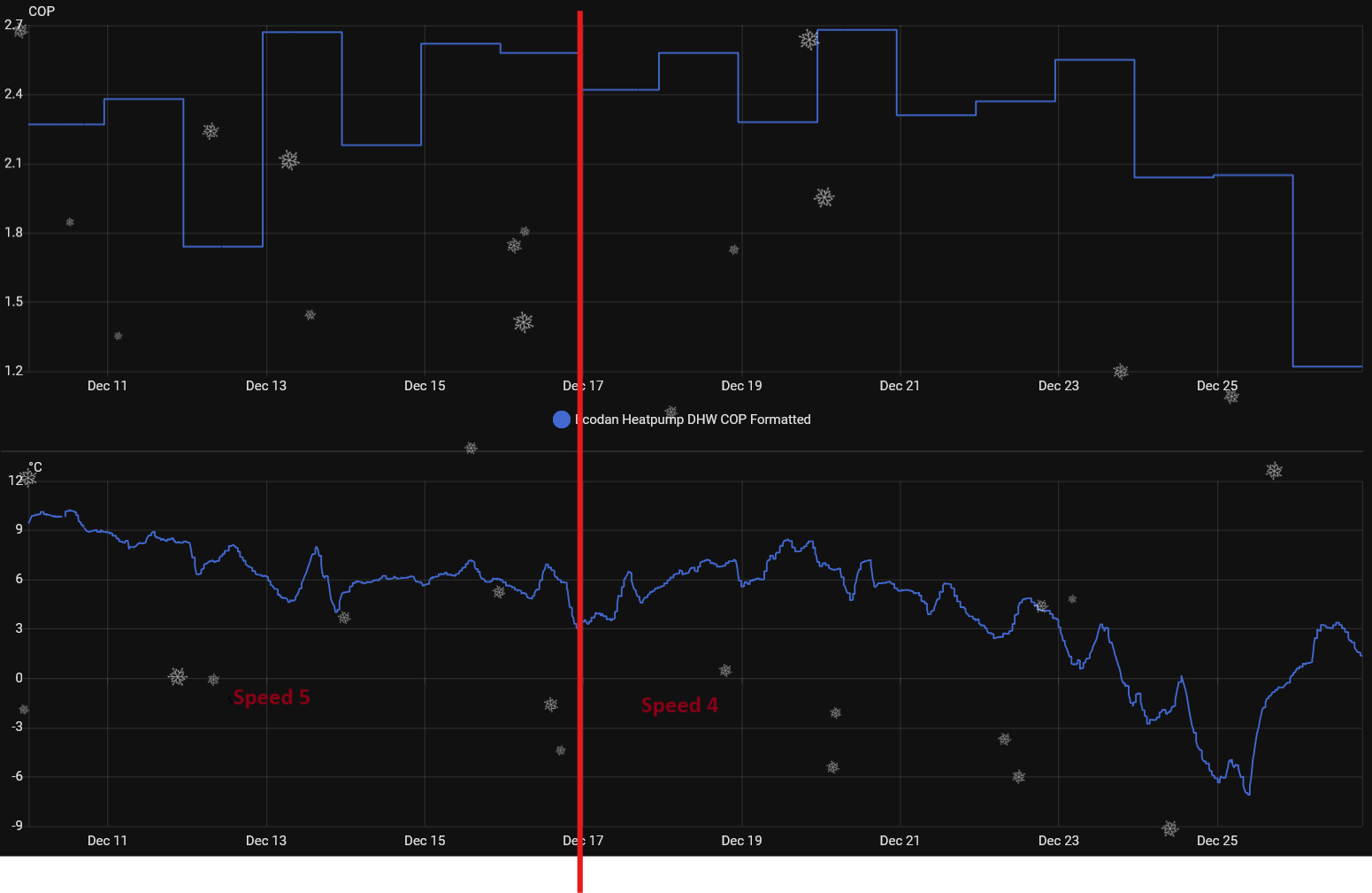
What about the pump speed for hot water production? I have tried a week with speed 5 and then a week with speed 4. Difficult to say if COP was affected since outdoor temp dropped a lot.