I have exactly the same issue. Daikin Heat Pump, Daikin preplumbed tank. Have used the document shared on here with no effect on the issue. I have even run as a test the Heat / Radiator side of the system at the same temperature as the hot water cycle and have no air issues reported when I do this, its only when the hot water cycle is run. Can’t make sense of it myself as I thought may be its the higher temperature but this test proved that not correct. So I am at a loss myself and frustrated by the reported ‘Data Errors’. Personally I suspect the heat measuring device is over sensitive / potentially faulty. Given that the Kamstrup model I bought is not available anymore from the store and this model has been commented on across many other forums with similar ‘air’ issues I suspect its the unit which is either faulty or overly sensitive hence it no longer being available now. When I feel like spending on the system again I might swap it out with a sontex to see whether this air issue is actually there or not….
Hi Matthew,
I have an Axioma Qualsonic E4 heat meter and that’s what is showing the air issue here in my Daikin HP and DWH tank.
I suppose another difference with the DHW cycle that may be relevant is that the flow rate is much higher than the CH cycle - and this may be what tips the heat meter into error?
Personally, I think my heat meter is probably working OK and that actually I do have air in my system. My frustration is that I can’t seem to shift it!
I’m going to tolerate it for a couple more weeks until we get some warmer weather and then do another cook-off as @Marko_Cosic suggests.
The Kamstrup units are high quality. They’re also high cost - hence the switch to axioms units that are functionally identical but more accessibly priced.
Sontex units will NEVER trigger error codes for air or dirt in the system because they use a different measurement technique. They’re blind to it; so will just report erroneous flow rates instead once it gets bad enough.
You have air in your hot water circuit OR air in the entire system but because the hot water circuit runs hotter or at a higher flow rate it’s only dissolving out of solution in hot water mode.
This will cause corrosion in your heating system over time. Not ideal.
Do those of you with these issues have inhibitor in your system?
@KnightPhoenix had this problem and inhibitor solved it.
Thinking aloud here : dissolved “air in the system” surely can’t only be in those OEM installations that are exhibiting heat meter errors. Surely it is a widespread effect in wet heating systems.
Perhaps:
a) it is self-healing in typical gas boiler systems because typically temperatures are hot enough to cook it off.
b) it has been fixed in properly commissioned low-temperature installations by the installers running programmes that release the dissolved gas.
c) it remains a problem in low-temperature systems that have never been purged or have been refilled.
Within this last group, its only those systems with sensitive flow meters that will ever be aware of the air problem and the damage that the air is causing to the installation.
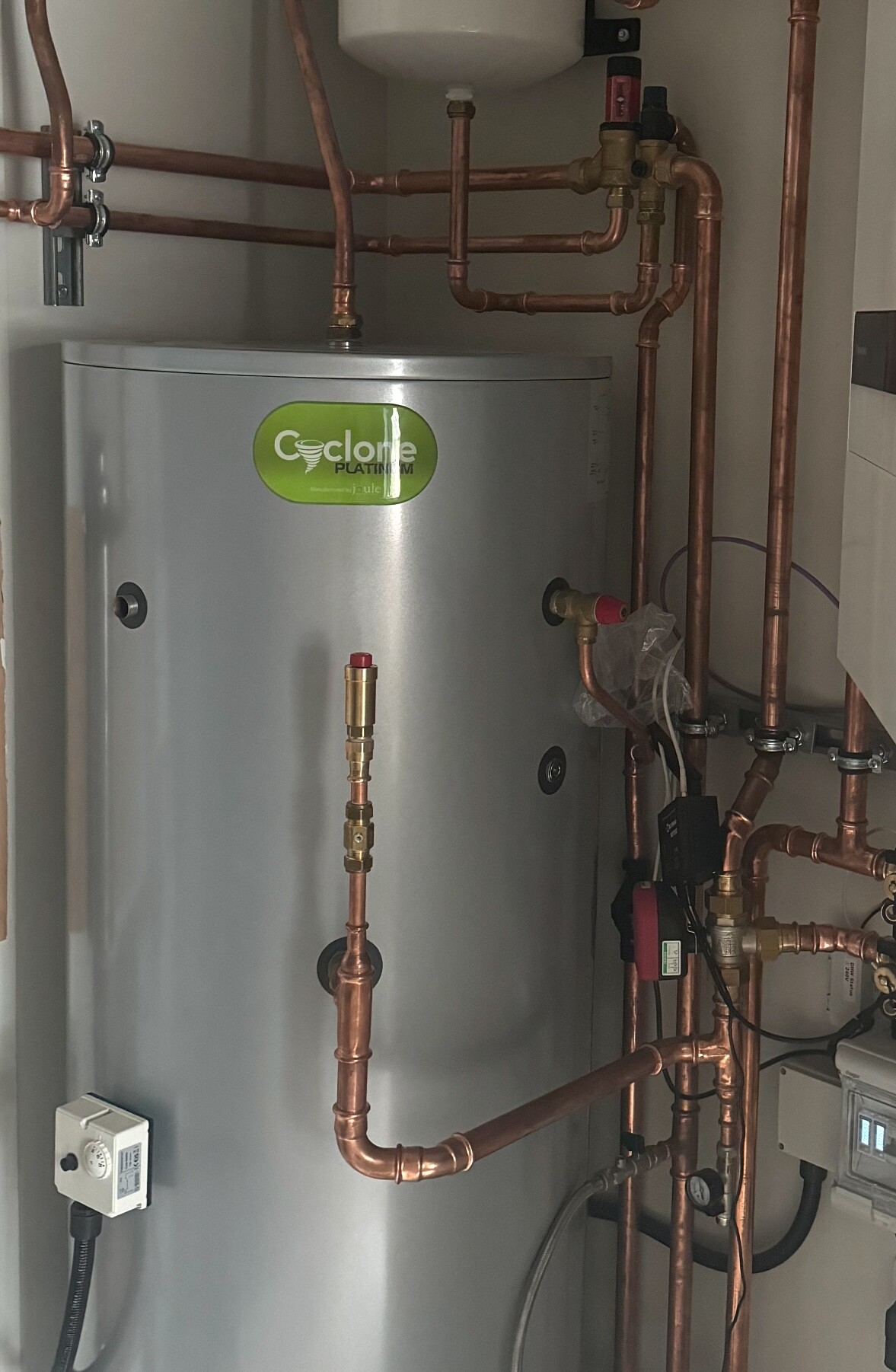
If you don’t already have one, a short length of pipe and air vent on the flow at the top of the cylinder coil will help remove trapped air. Also running the entire system through a fill & flush pump unit at commissioning will help remove the dissolved air, especially in UFH.
I hope so , but I have just ordered a checker which arrives on Tuesday
you c an slow the pump down in the mmi as a test
That sounds like hydrogen production from something rusting. If any radators I would always want inhibitor.
Yes, yes, and yes. 
Flowrates in DHW mode are so high that air remains “entrained” even after it has “dissolved out” - so it’ll only catch air bubbles when the DHW cycle comes to an end - which ought to be most of the coil contents but might not be. (say, on cylinders with corrugated coils that are delightful for providing lots of places for the air to hide out in the tops of the corrugations)
Exactly, it lets any trapped air out once it’s stopped circulating, rather than sitting there for the next cycle!
Does inhibitor purge the gasses out of the water or does it just mask the problem?
HeatGeek have an article on this topic Heating Water Treatment Explained (VDI 2035) - HeatGeek
In the article Heat Geek say:
What Does VDI Say About Using Inhibitors?
"VDI says to fill with potable water and only use inhibitors in extreme circumstances where it’s required, and that the engineer putting in the inhibitor should be appropriately trained in that chemical area.
and
If you are using inhibitors you need to be aware every time you chuck in a random bottle of inhibitor into your system, straight away you’re increasing conductivity and eventually, the inhibitor dies leaving this conductivity.
It leaves behind a high concentration of old soup and then you’ll chuck in another bottle because you need to top up the inhibitor. That will further increase the conductivity, then that inhibitor will die and so on. You simply end up with a corrosive soup and this kind of soup also leaves a huge amount of food for bacterial growth which is one of the main causes of pH falling out. Or you could fully drain the system every time and reintroduce scale… the choice is yours."
I’m not an authority on any of this, I’m just reading around the topic and, hopefully, picking up best practice.
Only if the coil is smooth and rising continuously up to the outlet - corrugated coils scupper this technique
If your problem is that the system isn’t airtight and gases are diffusing in (e.g. through cheap non air barrier pipework only suitable for potable water) then you won’t be able to cook these out and keep them out.
Inhibiting the corrosion with chemicals rather than removing the ingredients of the corrosion then becomes your only option.
It won’t fix the metering issue. You’d need to run a meter that is blind to contaminants. (mechanical or vortex shedding - with only the latter not having moving wearing parts)
I am looking at installing a “SpiroVent RV2 28mm Deaerator” which has max flow rate of 33 l/m. I am not sure if this is high enough as I am seeing spike flow rates of 32 l/m and a max flow rate of 27 l/m before the data stop recording and I cannot find max flow rate on the Daikin 8kw unit.
My second opinion is the IMI Zeparo ZTVI 1.25″ BSP F Deaerator which has a max flow rate of 50 l/m but unit does look cheaper in design or The bigger SpiroVent Junior which are cheaper , but I am not sure which would be better
Has anyone have any recommendations ?
Thanks
Mark
I expect idealy the pipe that connect to top of coil should be vertical above connection point, in a significant larger pipe size then rest of system with vent at top and connect to heatpump from a T part way up.
If a system have a volumizer, I would be tempted with value that short circuit the heating system so the complete flow only passes var the volumizer. (Maybe also emmerson heater in volumizer.) Then to cook off the air, temporary full open this “bypass” valve and run heatpump on maximum flow temperature and minimal pump speed with lowest system pressure heatpump will allow.
I’ve generally always put a air bottle/vent at top of coil, with flow pipe going up to it, seems to work a treat - and for what it’s worth I believe the Joule high gain cylinders we use have large smooth bore coils. A volumiser with air vent on top will help remove air due to the reduced velocity - I would recommend having fill & flush connections, often found on UFH manifolds, or add to primary pipework and use a flush pump unit with drum/container which will remove a lot of dissolved air if you run it until the water turns clear and handy for dosing with biocide etc.
REMS Solar-Push - Electric filling and flushing unit
I also generally isolate, or replace AAVs with manual vents after commissioning as they can be problematic and often end up leaking!
Hi Tony,
When you recommend fill/flush are you saying to discard the old milky water and replace with fresh? Or does this machine have some way of recycling the water after degassing it?
If the former, perhaps I’m misunderstanding, but won’t any newly introduced fresh water bring new supplies of dissolved gas to the party?
For flushing the water is recirculated - it’s pumped from the unit container, around the circuit and back, releasing the air when the pressure/velocity drops in the container. You just need to make sure the circuit is valved/isolated correctly to ensure proper circulation and not a short circuit - there are fill & flush valve sets available if need be…