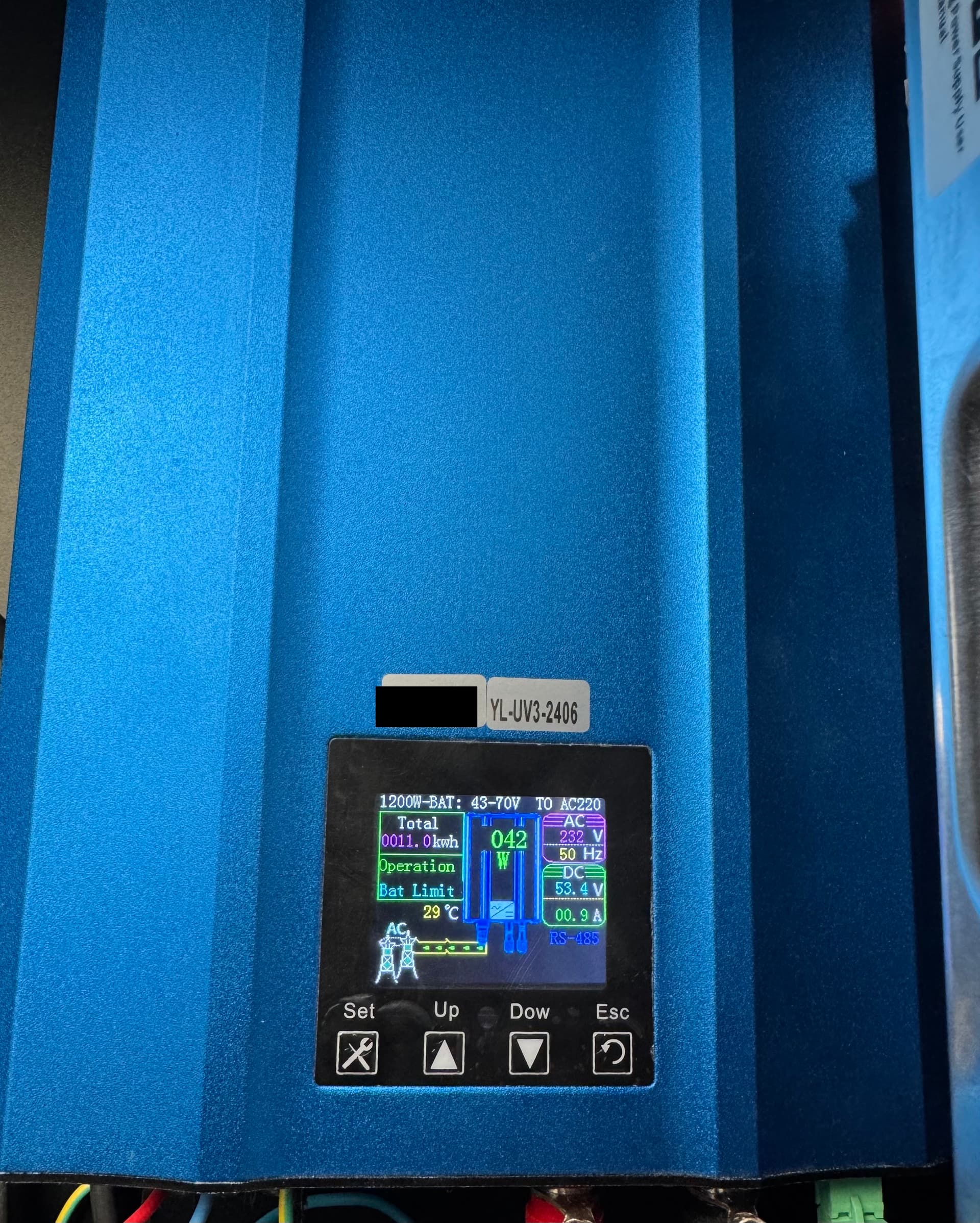
Hi—sorry for my English, and I’m not sure this is the right category.
I’ve been experimenting with controlling the YL-UV3-2406 inverter (with the limiter port) (lcd firmware: STC08-2403 / cpu ver-3.1-2403). the blue one from chinese famous website “TINGEN GTN”
Below is an Arduino/ESP32 sketch and notes for simulating the limiter over the RS485 port using an ESP32 + MAX485 transceiver.
Mods: please feel free to move or edit the post if needed.
In my tests the program works from 0 to ~900 W.
/*
===============================================================================
TECHNICAL NOTICE + CODE (ESP32 + MAX485)
Control a YL-UV3-2406 inverter via “Limiter” RS485 — 0..~900 W
===============================================================================

1) PURPOSE
Reverse-engineered, practical framing to set the inverter power setpoint via the
Limiter RS485 port using an ESP32 and a MAX485. Includes wiring, frame format,
checksum rule, command mapping (0x22 / 0x21), ready-to-use sketch, and notes.

2) HARDWARE
- ESP32 (e.g., WROOM-32 DevKitC)
- RS485 transceiver MAX485 (or SN75176 equivalent)
- Twisted pair for RS485 A/B, 120 Ω termination if needed
- Stable power (ESP32 5V USB; MAX485 VCC per module, 3V3/5V)
- Common ground between ESP32/MAX485/inverter

3) WIRING (TX to inverter)
ESP32            ->   MAX485                 ->   YL-UV3-2406 (Limiter RS485)
------------------------------------------------------------------------------
GPIO17 (TX2)     ->   DI
GPIO16 (RX2)     ->   RO (optional; not used here)
GPIO4            ->   DE & RE (bridged together)
3V3 or 5V        ->   VCC (per module)
GND              ->   GND                    ->   GND (common)
                   A  --------------------------->   A (RS485+)
                   B  --------------------------->   B (RS485−)

DE/RE: HIGH=TX, LOW=RX. If no reaction, try swapping A/B.
Line: 4800 baud, 8N1. Console (USB): 115200 baud.

4) FRAME FORMAT (8 bytes)
[0]  [1]  [2]  [3]  [4]  [5]  [6]  [7]
 24   56   00  CMD   G    X    M    CS
- Prefix: 24 56 00
- CMD: 0x22 → direct 0..255 W   |   0x21 → tiered >~255 W
- G:   tier/gain (depends on CMD)
- X:   value (depends on CMD/G)
- M:   0x80 (observed)
- CS:  checksum (see #5)

5) CHECKSUM RULE (MANDATORY)
Sum of all bytes modulo 256 must equal 0x23.
CS = (0x23 − ((byte0 + … + byte6) & 0xFF)) & 0xFF

Example (0x22, 100 W): 24 56 00 22 00 64 80 A3

6) COMMANDS & MAPPING (confirmed by measurements)
A) CMD 0x22 — direct 0..255 W
   24 56 00 22 00 [PW] 80 [CS]
   Examples: 0W→… 00 80 07 | 25W→… 19 80 EE | 50W→… 32 80 D5
             100W→… 64 80 A3 | 150W→… 96 80 71 | 200W→… C8 80 3F | 255W→… FF 80 08

B) CMD 0x21 — tiered ranges for >~255 W
   24 56 00 21 [G] [X] 80 [CS]
   Observed:
   - G=0x01 → ~256..~499 W, linear:      W ≈ 256 + 0.93 * X
   - G=0x02 → ~500..~640 W, base≈500,    slope≈1.00 W/step
   - G=0x03 → ~650..~850 W, base≈750,    slope≈1.20 W/step
   - G=0x04 → ~860..~900 W, base≈880,    slope≈1.00 W/step
   - G=0x05 → saturates ≈900 W
   Example (300 W): X≈(300−256)/0.93≈47 → 24 56 00 21 01 2C 80 DB

Notes: Display varies slightly with mains (e.g., 226–233 V). For 300–499 W keep G=0x01.
Above ~900 W a cap is observed.

7) SAFETY / DISCLAIMER
Use at your own risk. Ensure electrical safety and ratings compliance.
This information is provided for interoperability. Trademarks remain with owners.

===============================================================================
CODE (Arduino / ESP32)
Commands (serial @115200):
  p <watts 0..1000>   -> set target power
  g <gain 1..5> <x>   -> send CMD 0x21 directly (debug)
  raw <hex bytes...>  -> send raw 8-byte frame (auto checksum if length=8)
  @<ms>               -> period
  start | stop | once
===============================================================================
*/

#define TXD2 17
#define MAX485_DE_RE 4
#define BAUD_RS485 4800

// Empirical calibration (based on field measurements)
static const float BASE_G1  = 256.0f;  // CMD 0x21, G=1 — W @ X=0
static const float SLOPE_G1 = 0.93f;   // CMD 0x21, G=1 — W/step (~256..499)

static const float BASE_G2  = 500.0f;  // ~500..~640
static const float SLOPE_G2 = 1.00f;

static const float BASE_G3  = 750.0f;  // ~650..~850
static const float SLOPE_G3 = 1.20f;

static const float BASE_G4  = 880.0f;  // ~860..~900
static const float SLOPE_G4 = 1.00f;

// G=5 ≈ cap ~900 W (not effective)
static const float MAX_G5   = 900.0f;

uint8_t frame[64] = {0x24,0x56,0x00,0x22,0x00,0x00,0x80,0x07};
size_t  frameLen = 8;
unsigned long periodMs = 500;
bool txEnabled = true;

void setDriver(bool tx){ pinMode(MAX485_DE_RE, OUTPUT); digitalWrite(MAX485_DE_RE, tx?HIGH:LOW); }

void printHex(const uint8_t* b, size_t n){
  for(size_t i=0;i<n;i++){ if(b[i]<0x10) Serial.print("0"); Serial.print(b[i],HEX); if(i+1<n) Serial.print(" "); }
}

uint8_t cs23(const uint8_t* b, size_t nNoCS){
  uint16_t s=0; for(size_t i=0;i<nNoCS;i++) s+=b[i];
  return (uint8_t)((0x23 - (s & 0xFF)) & 0xFF);
}

void sendFrame(){
  setDriver(true);
  Serial2.write(frame,frameLen);
  Serial2.flush();
  setDriver(false);
  Serial.print("TX "); printHex(frame,frameLen); Serial.println();
}

// CMD 0x22: direct 0..255 W  -> 24 56 00 22 00 [PW] 80 [CS]
void buildCmd22(uint8_t watts){
  frame[0]=0x24; frame[1]=0x56; frame[2]=0x00; frame[3]=0x22;
  frame[4]=0x00; frame[5]=watts; frame[6]=0x80;
  frame[7]=cs23(frame,7); frameLen=8;
}

// CMD 0x21: tiers (>~255 W) -> 24 56 00 21 [G] [X] 80 [CS]
void buildCmd21(uint8_t g, uint8_t x){
  frame[0]=0x24; frame[1]=0x56; frame[2]=0x00; frame[3]=0x21;
  frame[4]=g;    frame[5]=x;    frame[6]=0x80;
  frame[7]=cs23(frame,7); frameLen=8;
}

// Map W -> frame (0..~900 W)
void buildPower(uint16_t W){
  if (W <= 255) { buildCmd22((uint8_t)W); return; }

  if (W <= 499) { // 0x21 G=1 (linear)
    float xf = (W - BASE_G1) / SLOPE_G1;
    if (xf < 0) xf = 0; if (xf > 255) xf = 255;
    buildCmd21(1, (uint8_t)lroundf(xf));
    return;
  }

  if (W < 650){ // 0x21 G=2
    float xf = (W - BASE_G2) / SLOPE_G2;
    if (xf < 0) xf = 0; if (xf > 255) xf = 255;
    buildCmd21(2, (uint8_t)lroundf(xf));
    return;
  }

  if (W < 860){ // 0x21 G=3
    float xf = (W - BASE_G3) / SLOPE_G3;
    if (xf < 0) xf = 0; if (xf > 255) xf = 255;
    buildCmd21(3, (uint8_t)lroundf(xf));
    return;
  }

  if (W <= 900){ // 0x21 G=4
    float xf = (W - BASE_G4) / SLOPE_G4;
    if (xf < 0) xf = 0; if (xf > 255) xf = 255;
    buildCmd21(4, (uint8_t)lroundf(xf));
    return;
  }

  // >900: observed cap ~900 W (G=5 not very effective)
  (void)W; buildCmd21(5, 0);
}

// ---- Console helpers ----
bool parseHexBytes(const String& line, uint8_t* out, size_t& outLen){
  outLen=0; int i=0, n=line.length();
  while(i<n){
    while(i<n && isspace((int)line[i])) i++;
    if(i>=n) break;
    int j=i; while(j<n && !isspace((int)line[j])) j++;
    String tok=line.substring(i,j); tok.trim();
    if(tok.length()==0) { i=j; continue; }
    if(tok[0]=='#') break;
    char* e=nullptr; long v=strtol(tok.c_str(), &e, 16);
    if(e==tok.c_str() || v<0 || v>255) return false;
    if(outLen>=64) return false;
    out[outLen++]=(uint8_t)v; i=j;
  }
  return outLen>0;
}

void setup(){
  Serial.begin(115200);
  Serial2.begin(BAUD_RS485, SERIAL_8N1, -1, TXD2);
  setDriver(true);
  buildPower(0);
  Serial.println("YL-UV3-2406 RS485 Limiter | p <0..1000> | g <1..5> <x> | raw <hex...> | @<ms> | start | stop | once");
}

void loop(){
  static unsigned long t0=0;
  if(txEnabled && millis()-t0>=periodMs){ t0=millis(); sendFrame(); }

  if(Serial.available()){
    String line=Serial.readStringUntil('\n'); line.trim(); if(!line.length()) return;

    if(line.equalsIgnoreCase("stop")){ txEnabled=false; Serial.println("TX stop."); return; }
    if(line.equalsIgnoreCase("start")){ txEnabled=true;  Serial.println("TX start."); return; }
    if(line.equalsIgnoreCase("once")){ sendFrame(); return; }
    if(line[0]=='@'){ long v=line.substring(1).toInt(); if(v>0){ periodMs=v; Serial.printf("period=%ld ms\n", v);} return; }

    if(line[0]=='p' || line[0]=='P'){
      int sp=line.indexOf(' '); if(sp>0){
        long w=line.substring(sp+1).toInt(); if(w<0) w=0; if(w>1000) w=1000;
        buildPower((uint16_t)w);
        Serial.printf("Target %ld W -> ", w); printHex(frame,frameLen); Serial.println();
        sendFrame();
      }
      return;
    }

    if(line.startsWith("g ") || line.startsWith("G ")){
      int sp1=line.indexOf(' '); if(sp1<0) return;
      int sp2=line.indexOf(' ', sp1+1); if(sp2<0) return;
      int g = line.substring(sp1+1, sp2).toInt();
      int x = line.substring(sp2+1).toInt();
      if(g<1) g=1; if(g>5) g=5; if(x<0) x=0; if(x>255) x=255;
      buildCmd21((uint8_t)g, (uint8_t)x);
      Serial.printf("CMD21 g=%d x=%d -> ", g, x); printHex(frame,frameLen); Serial.println();
      sendFrame(); return;
    }

    if(line.startsWith("raw ") || line.startsWith("RAW ")){
      String hex=line.substring(4); hex.trim();
      uint8_t tmp[64]; size_t n=0;
      if(!parseHexBytes(hex,tmp,n)){ Serial.println("ERR raw parse"); return; }
      if(n==8){ tmp[7]=cs23(tmp,7); }
      memcpy(frame,tmp,n); frameLen=n;
      Serial.print("RAW set -> "); printHex(frame,frameLen); Serial.println();
      sendFrame(); return;
    }

    Serial.println("Unknown command.");
  }
}