update on “The engineer did apply a known Vaillant dampening “fix” onto one of the panels, which was simply a sheet of stick backed plastic”
I had my second service a few weeks back and used Vaillant.
The engineer advised that the sheet was actually a rain fix, where it had been reported that water was getting into the back panel. NOT a noise dampening, as i posted. Apologies.
A permanent fix is applied to newer models apparently.
These ones are actually DN25s (1”), as they’re downstream of some steel braided flexible hose (initially attached by the installer) which apparently downsized the 1.25” connections exposed at the back of the heat pump. Other setups may differ.
I don’t yet have the means to measure the impact, so my answer for now will be subjective and imprecise. To answer your question unscientifically therefore, I would summarise the overall improvement as ~75%. I’ll try to explain:
Before the bellows were installed I would hear an uncomfortable resonance in different parts of the house, at varying compressor levels. I would also feel a slight vibration in the plasterboard on the inside of the wall where the pipes run up the outside of the house, especially at higher compressor modulations. I no longer experience either of those things. Win!
However, at lower compressor modulations I am still hearing a faint buzz and feeling some very slight vibrations closer to the heat pump, so it’s like the lower frequency vibrations are still having an impact. So, still a work in progress.
I have a few hypotheses that I plan to test over the coming days and weeks (since I want this issue as-close-to-eliminated as possible):
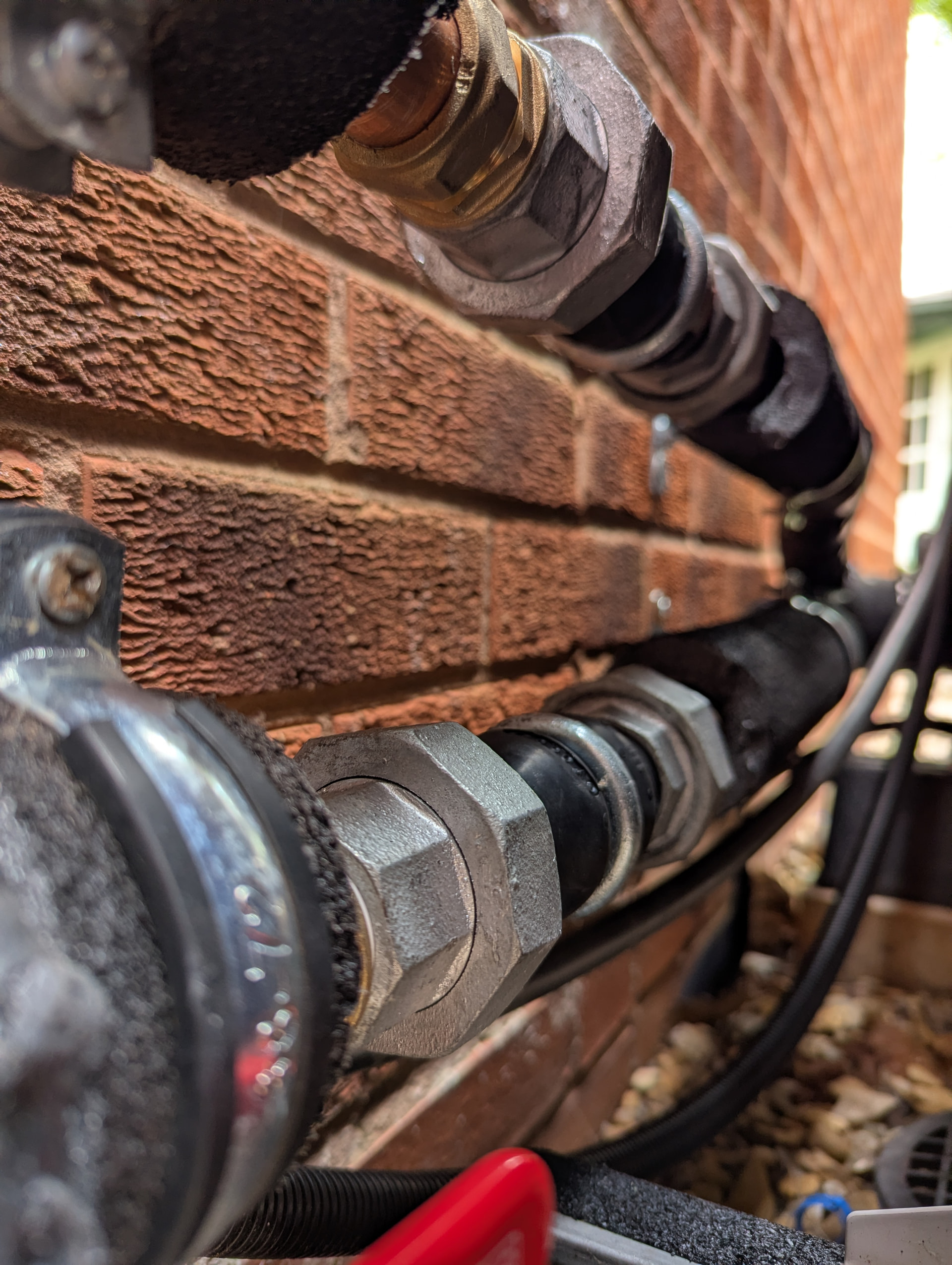
I suspect the flexible hosing that is immediately upstream of the bellows (see photo) may perform better if it were downstream of the bellows. The vibrations I feel on the connector at the end of the hosing furthest from the heat pump are arguably worse than those right on the back of the heat pump; it’s as if the the flexible hose exacerbates the low frequency vibrations. I may try to switch them round.
I suspect that the cheap lagging used on the pipework that runs up the side of the house isn’t providing any acoustic insulation, and the noise of the pipes is transferring into the house. I may try wrapping the pipework in something like this instead.
I suspect that the cheap clips that attach the copper pipes to trusses and joists as the pipework enters our house may be acting as an acoustic bridge into the building. I may try something like these instead.
given the positive impact the initial set of bellows had, I may try a second pair in a vertical orientation in case they help to eliminate residual vibrations on a different axis.
None of my proposals at the moment include moving the heat pump off the wall, since I don’t think the vibrations are transferring through the mount. Instead I think they are travelling through and emanating from the pipework.
Before I try any of the above however, I want to find a way to accurately measure the remaining vibrations in the pipes. Does anyone have any recommendations on how to do this?
Re insulation, I haven’t insulated them yet as I’m still tinkering with positioning, sequencing etc, however Google’s AI assist suggests that insulating rubber bellows might not be a good idea, citing reduced lifespan of the bellows. I’m a little sceptical of this summary and it’s relevance to lower flow temp domestic applications, so I plan to give FlexEJ (the suppliers of the bellows I use) a call when they open tomorrow. I’ll let you know what they say.
Not sure where you’re planning to position the bellows in your setup @Jason (in my opinion right on the back of the heat pump is probably optimal), but just a reminder that those anti-freeze valves will need to remain at the lowest point in your system. When a Vaillant engineer came out to us, prior to our bellows being installed, that was something he flagged.
I’ll be interested to hear what they say. I was thinking that we might use some extra large pipe insulation (like Primary Pro), but I didn’t want vibration to pass along the insulation, so I thought we’d split it into two sections and allow a small gap in the middle between them.
I called FlexiJ - always very helpful, and they advised not to put any thermal insulation around the rubber of the bellows. The reasons they gave were:
Insulation could inhibit the movement of the rubber and thereby degrade performance.
Insulation could cause condensation to build up on the outside of the rubber, which reduces the lifespan of the product.
I also learned that under normal operating conditions (which includes the temperature range that a domestic heat pump will be operating at) the bellows should last 5-10 years. The chap I spoke to suggested considering just replacing them at the 5 year mark.
Yesterday my installer, Darren Russell our local Heat Geek, installed a pair of the Flex EJ rubber bellows fittings on the pipework behind our heat pump. It’s early days but it seems to have worked brilliantly! I can’t hear a vibration anymore.
That’s brilliant news @Jason! I’m really glad they seem to be having a positive effect, and kudos for such a comprehensive video.
The reduction in hum you’ve experienced matches / validates the results we’ve observed.
I, like you, remain cautious however, as winter operations will really tell us whether or not further improvements are still required. Not only will the heat pump have to do more heating, but the air will be denser which in turn could impact the vibrations generated by the compressor (even though theoretically denser air means the compressor doesn’t have to work as hard). Time will tell!
In the meantime a couple of minor observations from your videos (all of which may or may not be helpful / necessary for you):
I plan to experiment more on this particular point, but we felt that having clamps attached to the walls upstream (from a vibrations perspective) of the rubber bellows lead to more vibrations transferring into the house. I installed the clamps to the right of the bellows in my photo above, and the following morning both my wife and I agreed we recalled a new hum (albeit not especially strong) occurring during the night. After I removed the clamps (and let our flexible piping that comes off the back of the heat pump hang suspended again) we no longer noticed that hum. Again - subjective, and needs more data, but might be something to consider.
When a Vaillant engineer visited (prior to us installing the rubber bellows), they suggested using a rubber strip between the clamps and the bricks to reduce vibration transfer. I can’t say whether it’s helped us at all, but it seems like an easy thing to do. I’ve also used rubber washers for the screws.
Like yours, our plumber also used clamps that clasped around the insulation rather than directly around the pipework. As an experiment I installed new smaller clamps that held the copper pipes directly (in my photo replacing the clamp on the upper pipe, and on the lower pipe adding a new clamp to the right of the existing larger clamp), and we’ve noticed a further reduction in low frequency vibrations (emitted when the compressor is working between 25-30% modulation). I now plan to add insulation back around those clamps. (Full disclaimer: I am not a plumber, clamps around the pipes and inside the insulation may create other problems I’m not yet aware of).
As I say, your vibrations may already have dropped to a satisfactory level, in which case the above can be disregarded. Also I’ve come to the conclusion that a lot of the tweaking I’m doing is a dark art, and depends on many factors, like the design of the house, building materials etc etc.
In any case, please keep us posted! I’m sure we’ll be in touch again by November
Hi @pippyscottins, thanks for getting back to me. Yes, the Flex EJ fittings have worked very well. I really appreciate you finding them and giving us the inspiration to try them for ourselves.
Aside from placing some PrimaryPro insulation over them in the autumn, I’ll probably just leave them alone for now. It seems to me that the vibration we heard was coming in through the pipework and not through the walls. The clamps Darren used have rubber dampers where that grasp the insulation, and I couldn’t feel any vibration in their metalwork even when I could definitely feel it in the insulation itself.
Anyway, things are much improved here, so thanks again for the advice.
Cheers
Jason.
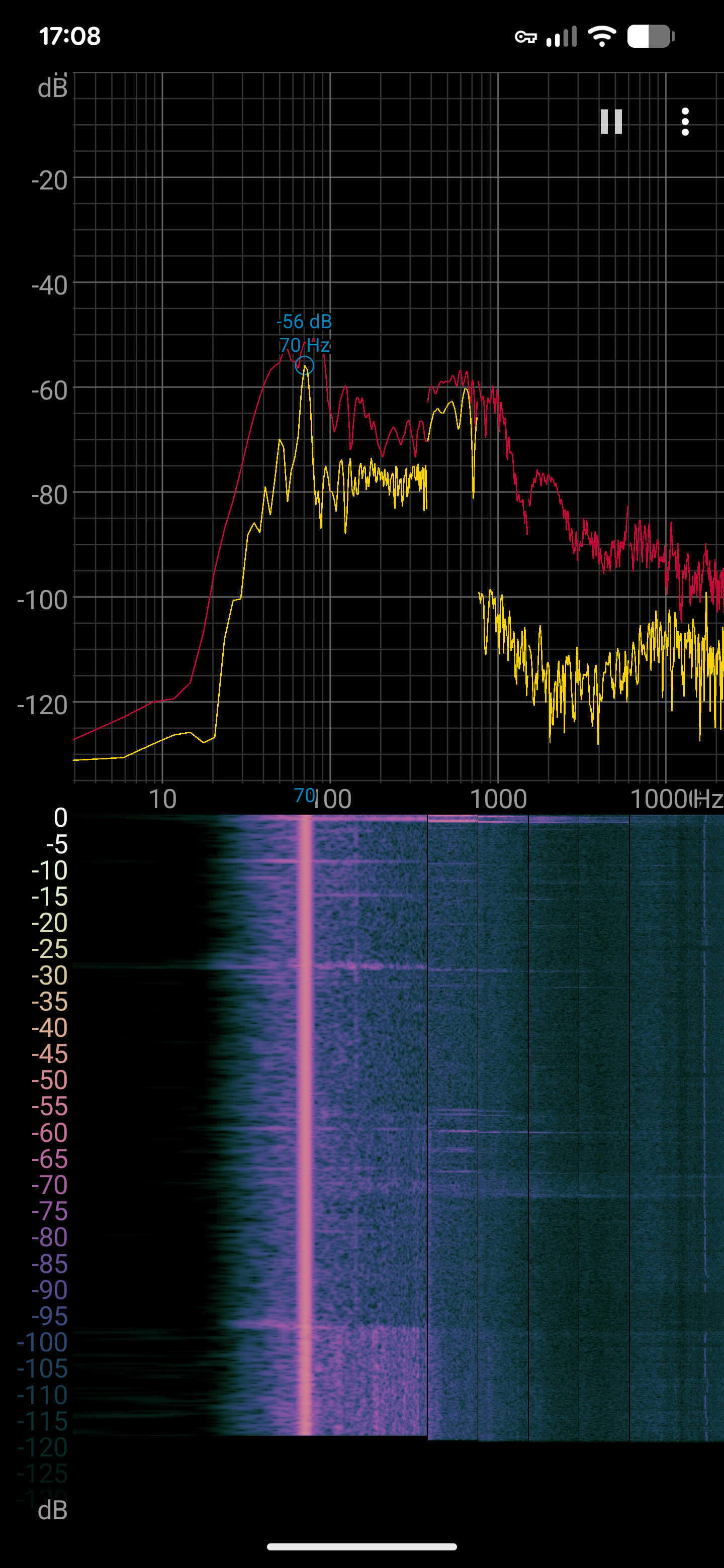
Use an android app that has an an acceleration spectrum graph (like phyphox) Don’t try to capture such noise with a microphone, it won’t work.
Just put your phone on any surface and capture the problem frequency and it’s resonances. You’ll then be able to see it easily and do so repeatably in an arbitrary magnitude (FFT) which you can compare.
I was just wondering why people were posting saying it’s hard to quantify.
Microphones in phones and RTA gear will have low pass filters that are unavoidable so any dB(A) measurement almost useless to track these down unless it’s unbelievably loud.