How did you take PWM control away? I don’t have problem with cycling but to keep the target flow stable. Simply when flow temp reaching the target the pump start to panic and start to change compressor frequency erratically in big increments instead of 1 or 2 hz up and down.
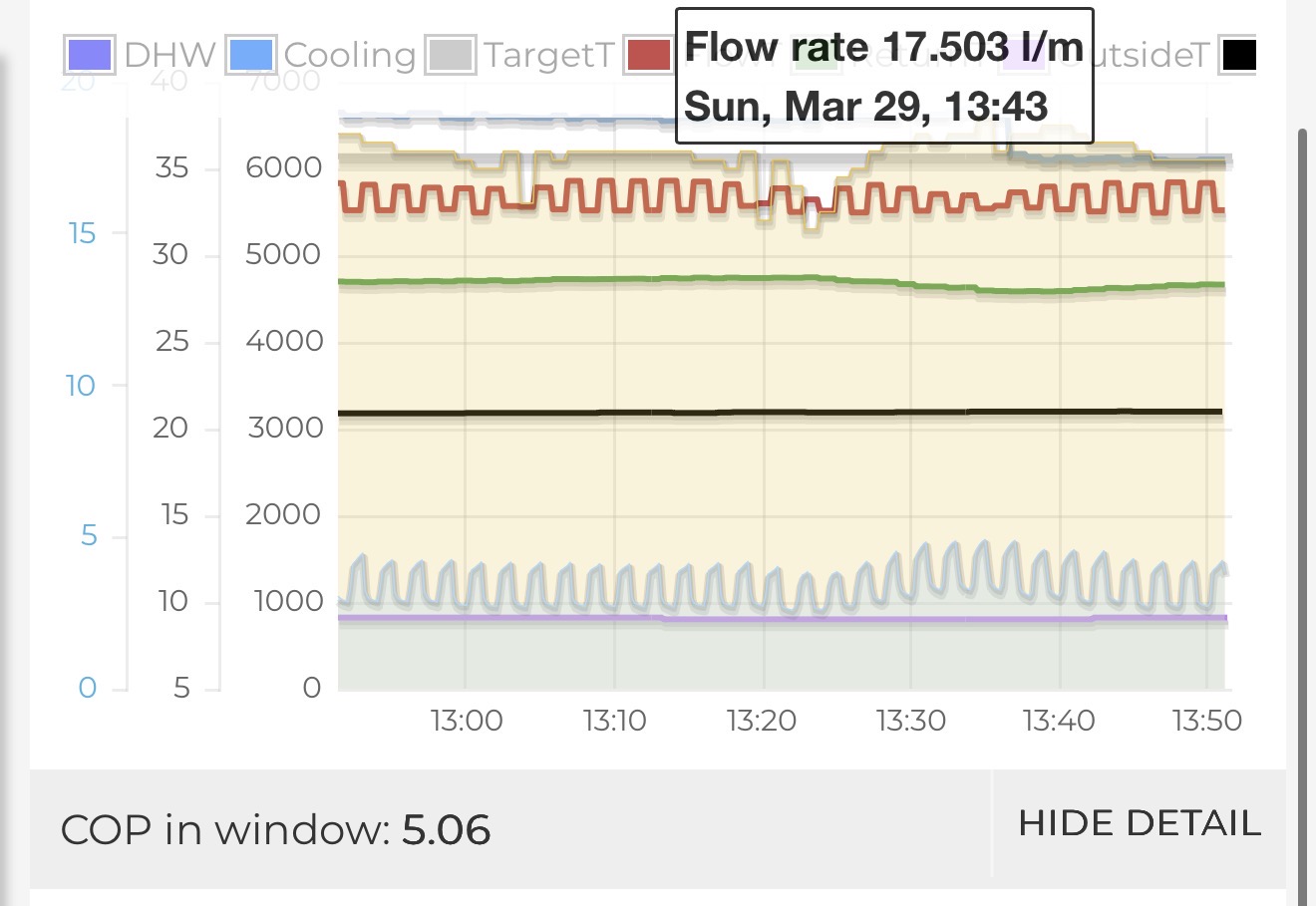
As you can see, I force the compressor to (pretty constant) minimum speed (magenta line), where it stays for hours at a time. I had #2091 set to 1 and allowed LWT to find it’s own level. I set WL down by 10degC at 10:40 after post-setback house rewarming was complete. The roomstat was finally satisfied at about 12:45, and switched the compressor off for about half an hour until hysteresis kicked it back in. The new lower minimum inverter speed of 14Hz roughly matched house heat loss so the compressor ran interupted until evening. No PWM as you can see from the black line.
So it may not be the most efficient HP on the market, but I’m quite glad I went with Samsung…
I currently set the flow temp dynamic the next experiment would be WL with the setting that keeps it on until room temperature overshoots and see if that yields different results. Last time it didn’t
I just cannot understand this negativity toward the Samsung HTQ. Mine works perfectly as advertised as a boiler replacement solution. Whole house constant 19c in depth of winter. SCoP is class leading.
The latest firmware resolves the LWT modulation so that it will vary by upto 3 degC based on the MIM room thermostat giving a constant temperature without on/off compressor cycling. ( yes really! see below )
I have experimented with increasing radiator size and found it improves performance but you can run it at higher temperatures if you are stuck with small emitters.
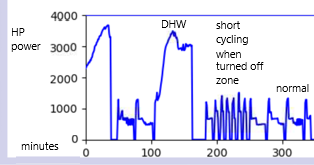
The above short cycling I can reproduce by when accidentally allowing the upstairs zone to shut off on a thermostat - it does warn about this - I now keep all zones fully open so that the volume and heat load is constant.
see above - rapid short cycling every 5 minutes when the zone closed resumed normal cycling when opened
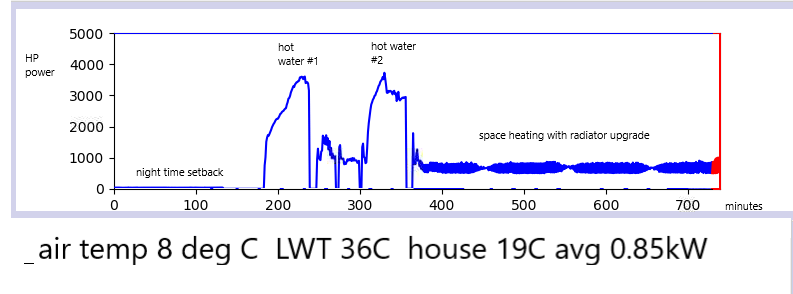
I doubled the radiator sizes in the downstairs rooms and you can see the effect here. The compressor load is more or less constant and more efficient like this. very satisfying.
as I say this is an ingenius two stage HP a bit more expensive but hey! it heats DHW to 60c with a CoP of 2.5 which is worth having if you use alot of hot water like we do.. (No problem with heat stealing on frost protection if the coil is at the bottom like on UK DHW tanks). Easy to install with existing UK plumbing no buffer tank or volumizer needed - in fact no plant room at all which is what they intended as an option for some markets. I would not hesitate to recommend it for retrofitting into UK homes.
Well said, @designerguy. My new neighbour is interested in fitting an HP and I will definitely be pointing him in Samsung’s direction.
Main question will be: HTQ series which I am just beginning to get the hang of (2-stage compression so very few defrosts, also fairly flexible and efficient, easy and cheap to monitor, reliable so far…) versus R290 Gen7 series which I don’t know anything about (except better thermodynamic efficiency than R32, better GWP).
Has anyone out there operated both, so might advise please?
I have a Gen6 8kW R32 unit which has been slightly disappointing. It works well if the outside temperature is above 6C but performance drops significantly below this. (It also has a noisy compressor.)
I’ve spent a lot of time looking at different replacement options, including Samsung units which would be the easiest drop ins. I was interested to see that the HTQ units perform better than the R290 units according to the Samsung specs.
At 2C/35C water 12kW HTQ CoP 4.3, 12kW R290 3.6, 8kW R32 2.98
Thanks @billt. I think my neighbour can discount the Gen 6 - according to the Midsummer website this range is being withdrawn from sale later this year.
Those CoP numbers surprise me slightly - R290 physical properties usually result in better overall efficiencies than R32. That they apparently don’t is probably down to the economiser circuit that the HTQ range incorporates but the R290 range doesn’t. The economics of the two ranges are probably a wash (Samsung are usually pretty shrewd when it comes to pricing), so for my neighbour it’ll probably be down to his environmental worries or lack of. (R290 GWP = 3 versus R32 GWP = 675.)

 What’s wrong here then? Can’t get it.