Update: Good news! After disabling the BT50 indoor sensor at around midnight last night, the system is now running today with the expected WC flow temp today. It’s maintaining a constant 20.5C, I’m very happy with this so far.
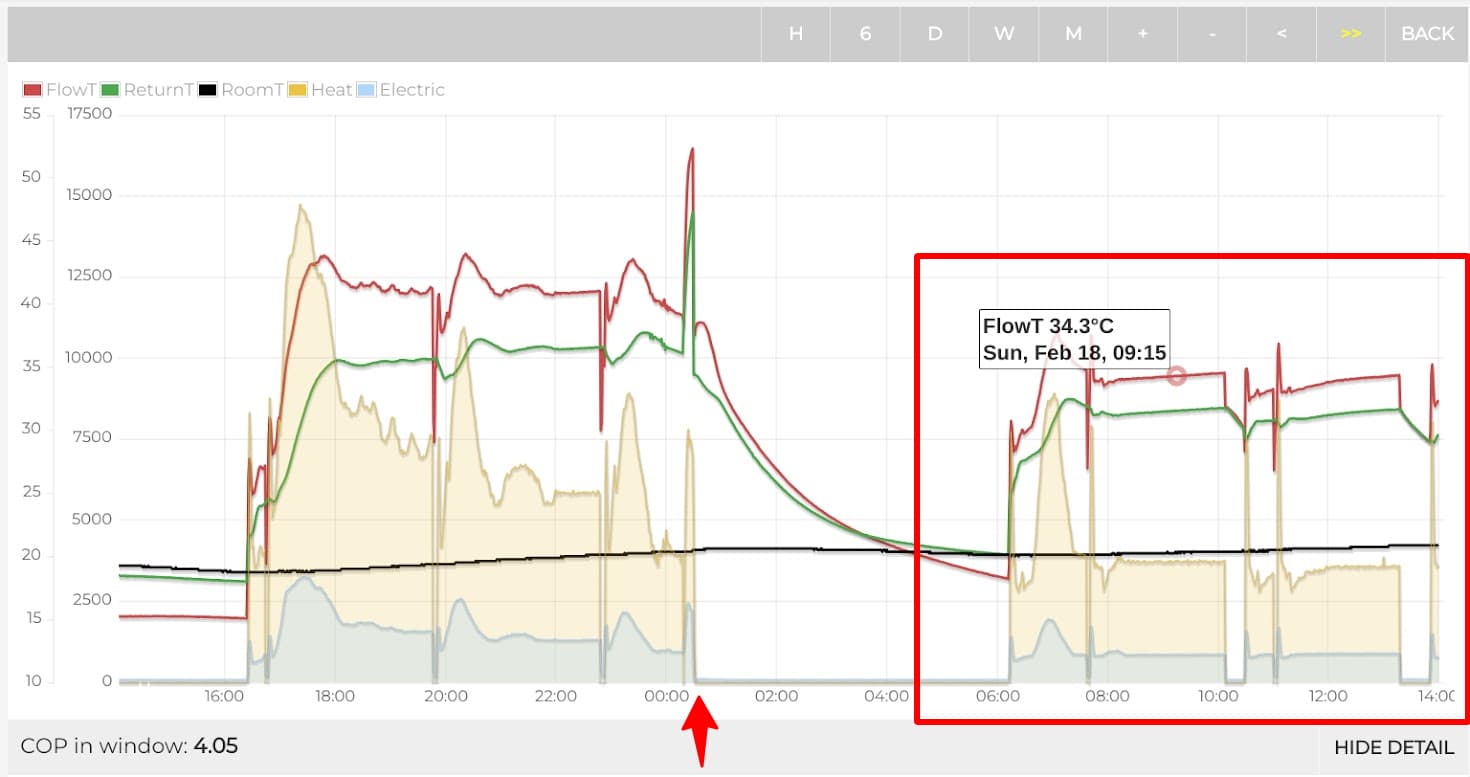
That’s a very good point. The system is fully open-loop with just a single circulator, there are no pumps on the manifolds. The BT25 sensor is located just above an insulated volumiser, so once the circulator stops, it will take a long time for the temperature the sensor sees to decay. This would explain why there’s such long gaps in between runtimes, I’ve now set the circulator on ‘Auto’ and set it to run at 10% between cycles. I’ll report back what difference this makes…
Are there any settings to set how much influence the BT50 indoor sensor has? It seems in my case it was having too much influence, coupled with the slow response time of UFH.
In my case the BT50 is located in a windowless hallway, so wouldn’t be much use for sensing solar gain, in fact the hallway is a terrible place since it’s adjacent to the front door, so would be getting a cold bast of air every time the front door is opened! I think it’s best I keep it disabled!
Interesting, thanks for sharing your findings. I agree, I’m sceptical how much load shifting is possible with a heat pump without a battery being involved. Possibly if a house is very well insulated with a lot of UFH thermal mass it might work, but for most houses I don’t think people will want the temperature to drop and the inefficiency of the HP having to work harder to re-gain the lost degrees.