Based on what I’ve read, the general consensus seems to be that for an average setback (about 3-4degC for about 8h each day), and on a fixed tariff, the extra cost of reheating the house at the end of setback (with the compressor running flat out for the first few hours) more or less cancels the saving from not heating the house at all during setback. In other words, it doesn’t make much difference whether you run a setback or not.
But if you have an attractive TOU tariff (e.g. Economy 7 or whatever they call it nowadays) the picture changes - it depends when you operate your setback, as well as the tariff difference between peak and economy. You would need to do the calcs based on your own situation/tariff/preferences, but the minimum operating cost may occur if you run a setback, but schedule the end of it a couple of hours before the end of cheap rate (so the high power consumption that follows restart happens when it is cheaper).
A further complication is that some heat pumps (e.g. Samsung - I can’t speak for Grant) have a decidedly better efficiency when running flat out, rather than just trundling along at half speed or whatever. If this is the case, some setback may actually result in lower running costs because the house reheat is done at a better efficiency.
Finally, there are comfort considerations. Some folk prefer a cooler house overnight, so a stopping the heating for a few hours may make sense. Equally, getting out of bed when the house hasn’t yet warmed up completely would not suit everybody. Comfort may be worth paying a little extra for…
Well thats good to know since I have a TOU tariff and a Samsung As you say it may be better not to initiate a setback, but I still want to know why its not doing it LOL
A further complication is that some heat pumps (e.g. Samsung - I can’t speak for Grant) have a decidedly better efficiency when running flat out, rather than just trundling along at half speed or whatever. If this is the case,
Is that really so? It doesn’t reflect my experience with a Gen6 8kW. CoP when running flat out from a cold start CoP of about 5.5, nearly 9kW output. When running at minimum input (350W) it has a CoP of 7.
Maybe I’m guilty of sloppy terminology here, @billt. By “flat out”, I meant “high compressor speed” (50Hz inverter frequency or more) rather than “high output” (in kW). I can’t see your inverter frequencies on your plot so it’s hard to draw the necessary conclusion from it.
Secondly, maybe I have over-generalised, and should have said “certain Samsungs”, because my position on compressor BEP has largely been gained on my HTQ range Samsung. Uniquely (I think) amongst Samsung HPs, this range embodies an economiser circuit along with some additional controller algorithms. Quite possibly these are affecting apparent CoPs on my unit in ways that would not apply to non-HTQ Samsungs.
Thirdly, when trying to correlate compressor speed with efficiency, it is important rule out the effect of varying compressor pressure ratio (polytropic efficiency obviously varies with pressure ratio). This is not easy because usually when the compressor is running at high speed the discharge pressure is rising fairly rapidly. The best approximation I have come up with is to use LWT and OAT as analogues of discharge and suction pressure, and compared CoP measurements over varying machine speeds when these are constant.
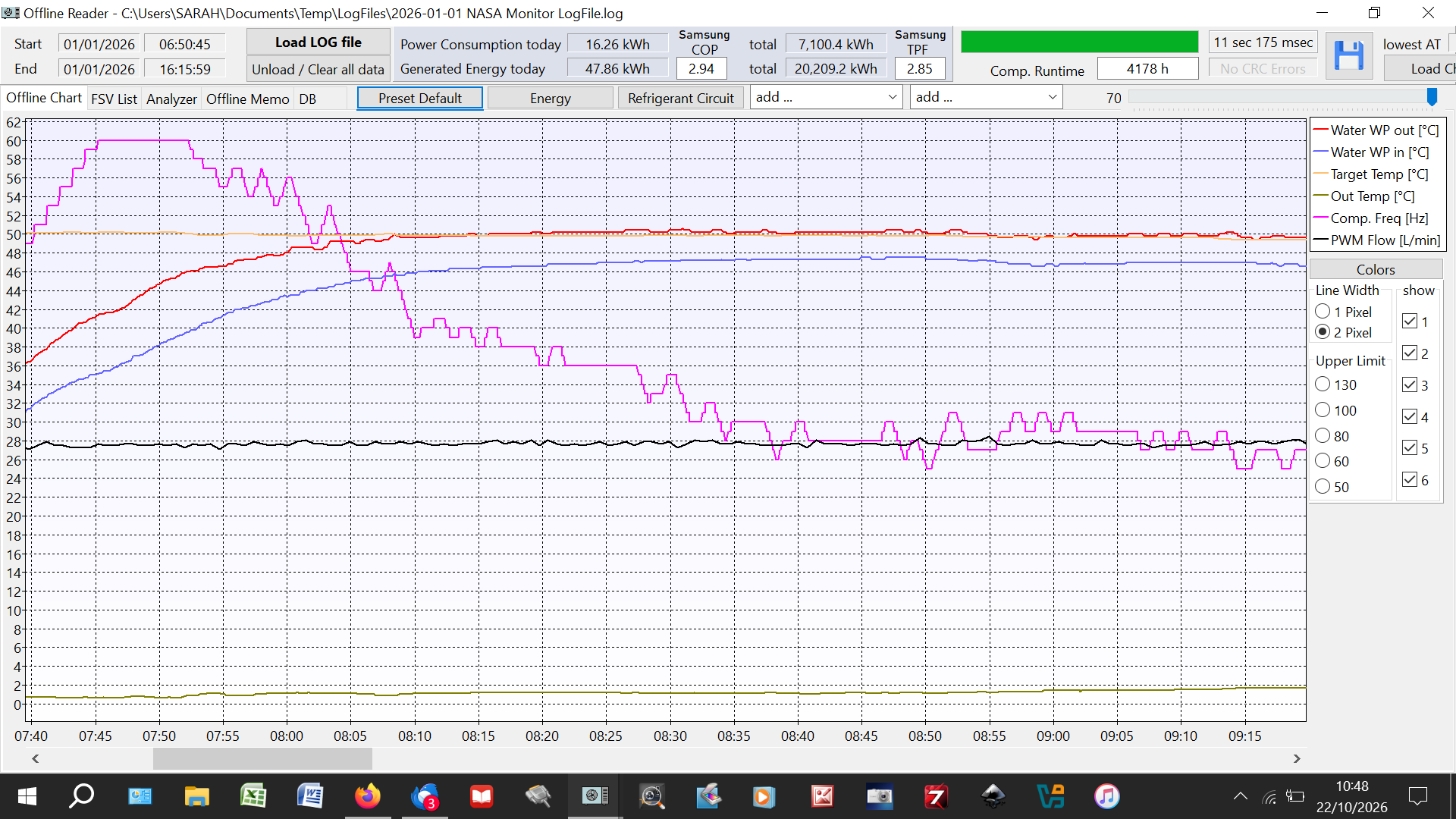
As an example, here are a couple of displays from earlier this year:
The LWT (red line first chart) and OAT (brown line first chart) are roughly the same at 08:00 and 09:00 (49degC and 1degC respectively) so the compressor pressure ratio should be roughly constant over this time period.
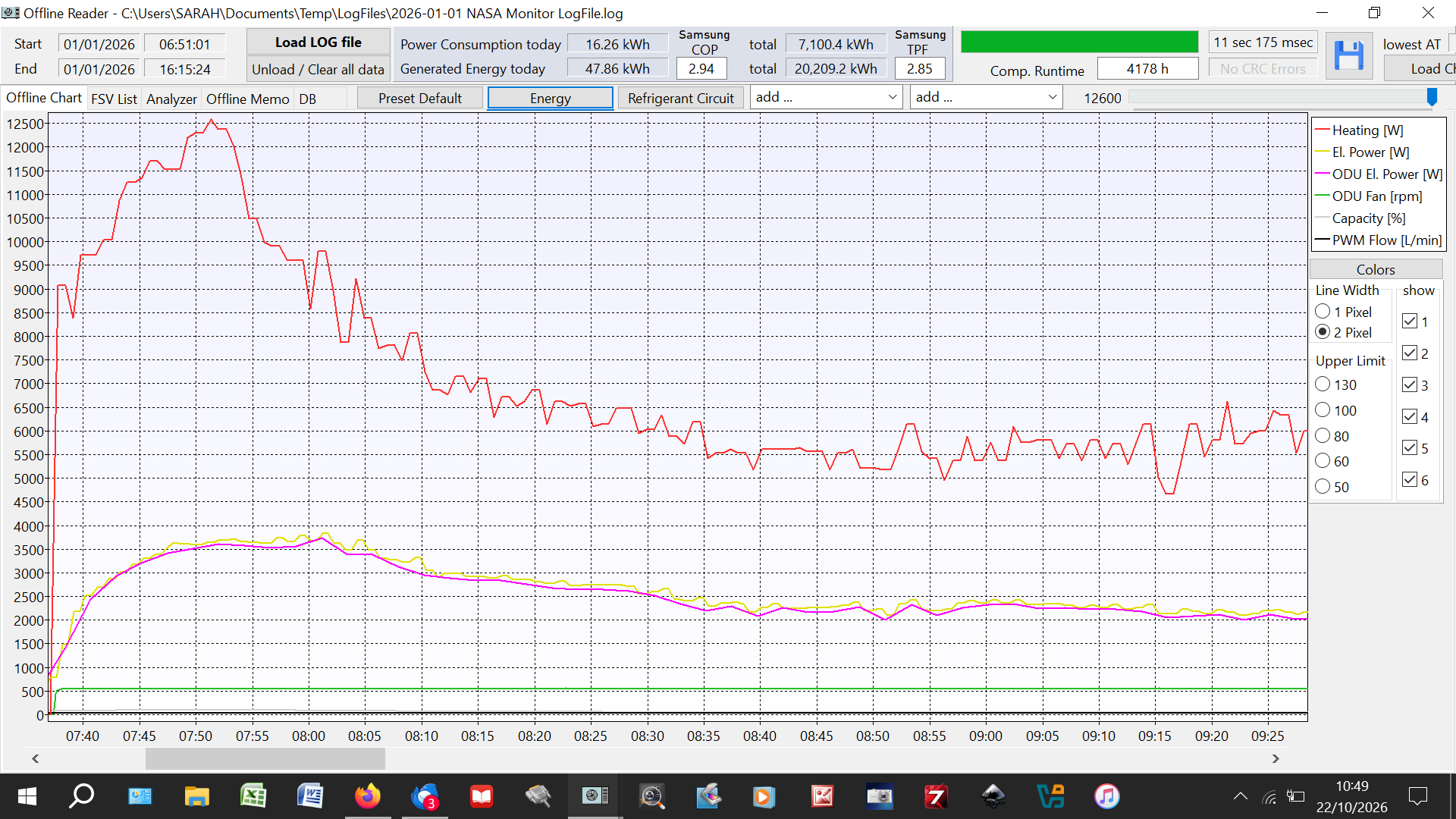
The compressor speed (magenta line first chart) was about 52Hz at 08:00 and about 30Hz at 09:00. The second chart shows energy produced (red line) and power consumed (yellow line) over the same time period. At 08:00 these are about 9000W and 3700W (CoP = 2.43), and at 09:00 they are about 5500W and 2400W (CoP = 2.29) - a 6% reduction. This should not be unexpected given that some power draws like the fan (green line second chart) and fixed speed circulation pump (black line first chart) are constant irrespective of compressor speed.
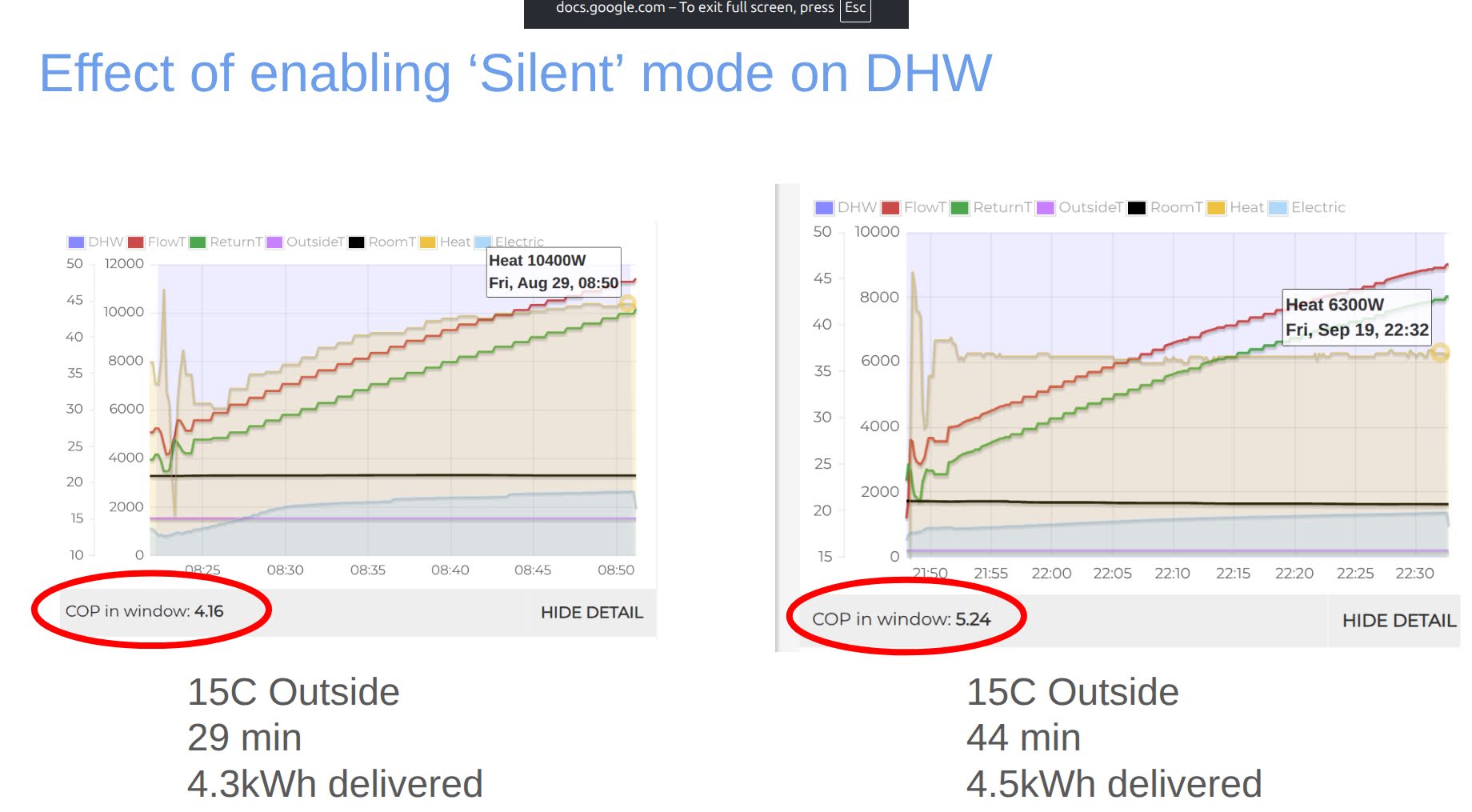
Grant heat pumps and most other heat pumps that I’m aware of seem to run more efficient at lower modulation e.g enabling silent mode on Grant reduces caps the compressor output, this significantly improves efficiency:
Vaillant have a similar DHW Eco Mode feature which limits compressor output during DHW, this also results in increased efficiency, at the expense of a longer DHW re-heat.
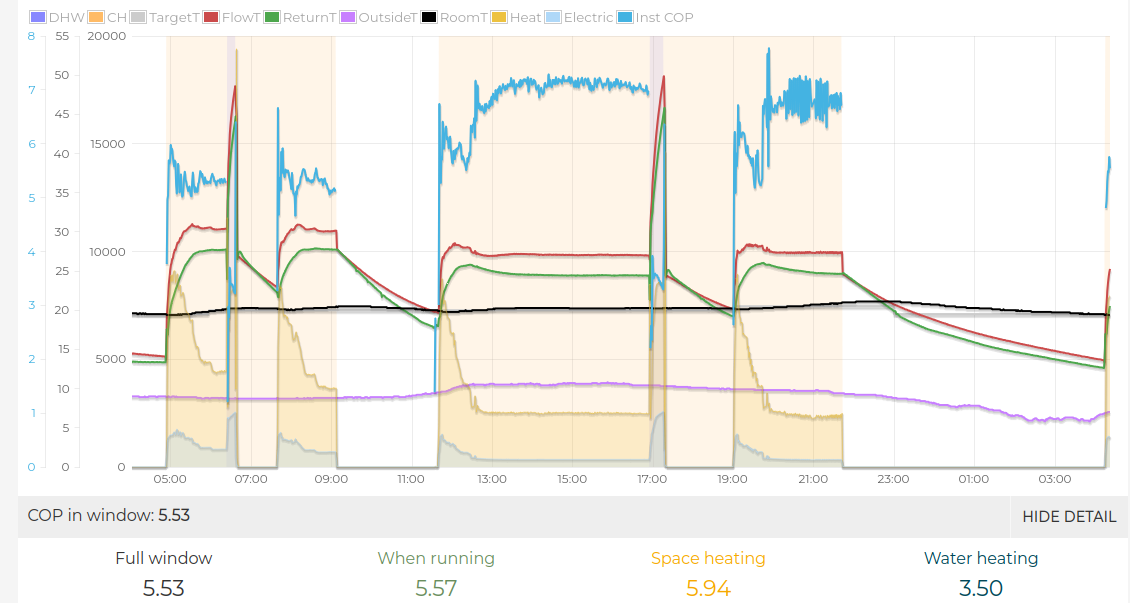
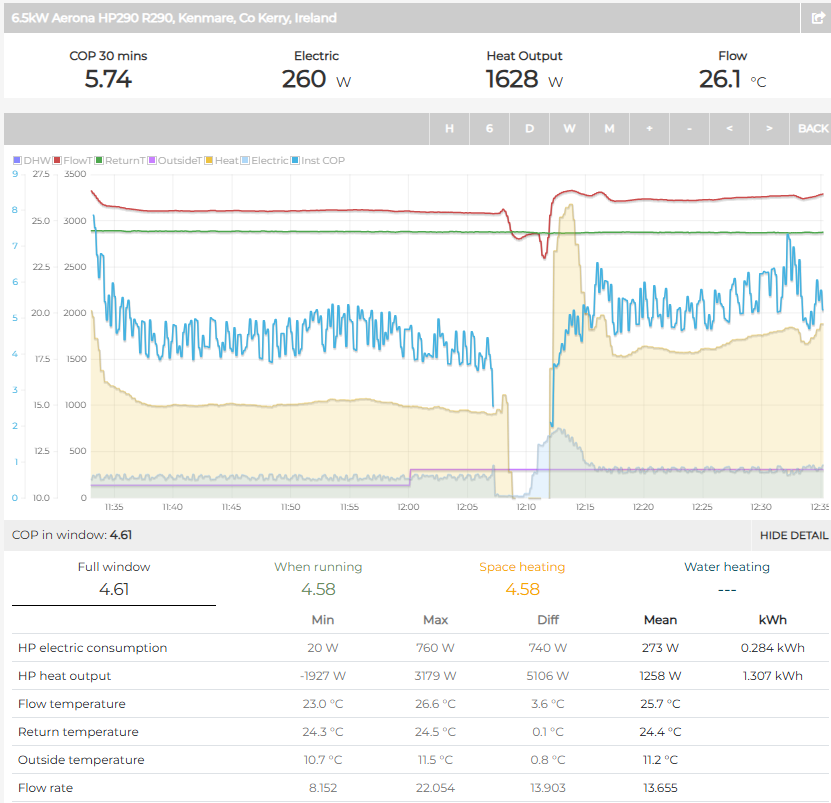
I was just looking at the figures there, the SCOP seems to drop off when my Grant drops down to the low-end modulation. I think there is a sweet spot - but very low end modulation doesn’t seem to be it. Is there anyway I can export the data to do some analysis on AI?
Yes, I’ve noticed this on the 6.5kW. What firmware are you running? I think I heard that Grant had fixed this on newer firmware, I could be wrong. I don’t see this with my 9kW HP290.
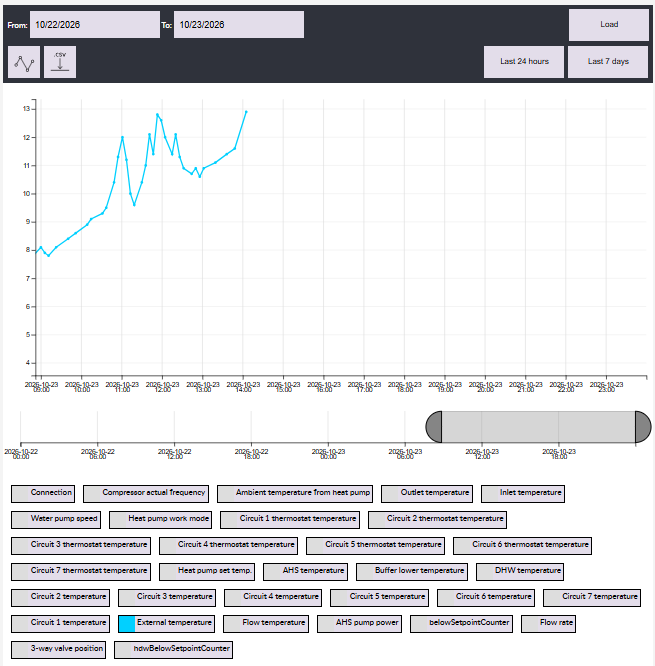
But also it looks like the outdoor temperature increased in your screenshot above.
I had Grant out about 4 weeks ago, so I suspect I am on the latest patch. But I need to follow up with them, as I suspect the patch has an issue; I have to force the parallel shift up by +5 to get it running in weather comp after the DHW finishes. It worked fine before the patch - tried the various settings, but still need to force it.
It does modulate very low - I submitted a sample of it outputting 654w. The cop does suffer, so you’d be better off stopping the unit for an hour or two than modulating very low. The temp did increase at that time:
On a side note: The temp you use seems to be off by a few degrees; it’s more noticeable at lower temps. Last weekend we got down to zero, but OEM was reading 7 degrees. Google also had zero or 1.
Will try to extract the data and see what AI thinks is the most efficient operating range.
 As you say it may be better not to initiate a setback, but I still want to know why its not doing it LOL