Samsung heatpump strange behaviour

I have AE120MXTPEH paired with AE160BNYDEH that is feeding total of 8 underfloor loops with max lpm of 20. The loops are hydrostatically balanced and they stay in ~0.5C band temp difference in their returns to manifold. Heating area is approximately 150m2

This is an 8 hour snapshot from last night. Outside temperature around 6C. Compressor capped to max 60% (translating to 30Hz) via 0x42F1, if not capped it goes into on/off limbo, I am not able to dissipate more energy, the sizing of the pipes must have been done wrong, its 20cm spacing, or something else, anyhow. There are no thermostats or water laws, manifold returns are fully open, DHW off.
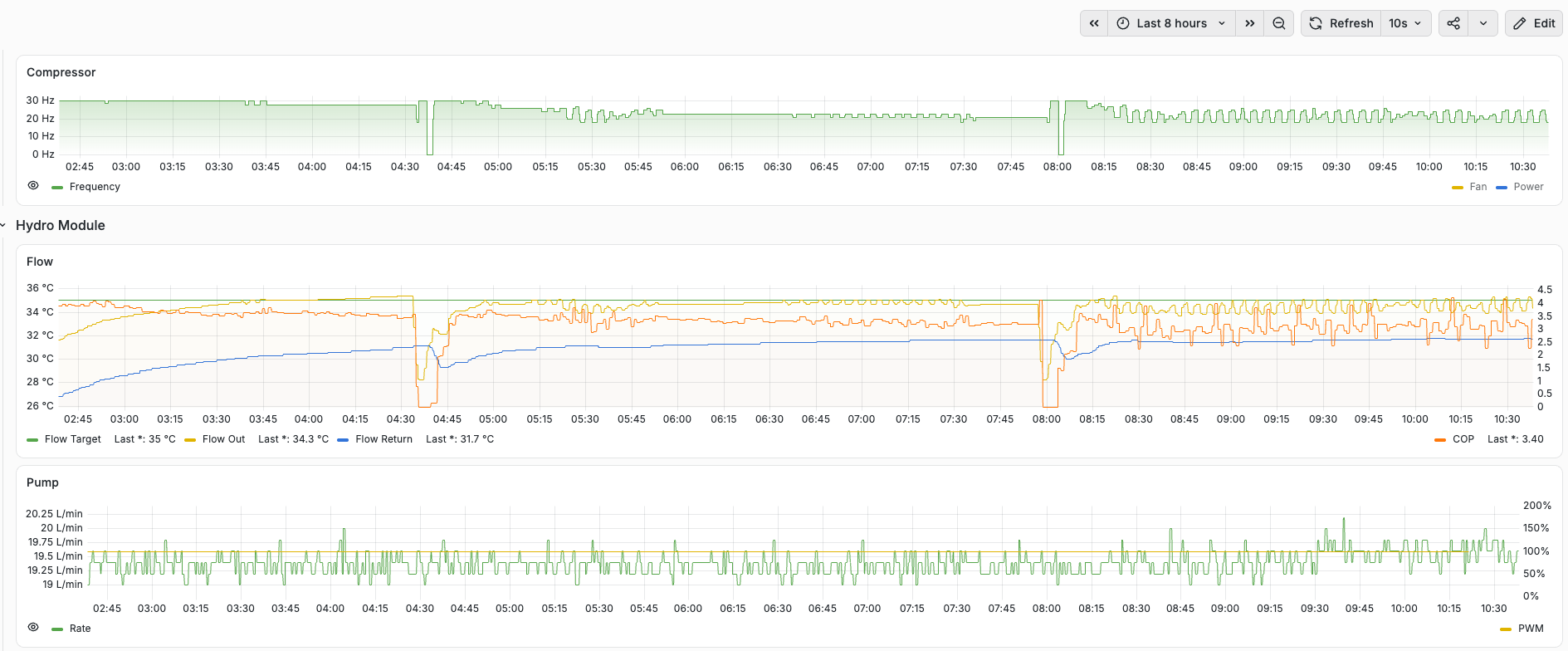
I have couple of questions regarding the operation of the system. Will be very thankful if there are experts here that can make any sense out of this.

  1. I do not understand the events around 4:30am and 8:00am, the first one appears to be close to a slight overshoot of the return temp over the target, but the second one is mystery to me. They both have similar graph signature and they both kept the compressor off for exactly 90 seconds. During this two events it appears that the hydromodule actually started to cool down the flow. The question is, what are those events, where did the heat transfer? there was no defrost recorded, also outside temps did not suggest one, why they are messing perfectly balanced system and sending it in a frequency hunt again, the system never recovered after the second event, i have to pull the plug on it.

  2. Water pump never received instructions other than 100% PWM but it is also visible that it is hunting for something (delta T target is set to 4C , control factor is 2) why the lpm is changing, does the built-in pump also have some own microcontroller or there is something else going on here.

I am storing full history of all registers in influxdb and can query any history data if that will be helpful.


Hello @Maksimilian and welcome.
Can you give us your FSV #209* and #405* settings, please?

So do you run a fixed temperature all the time, if so how are controlling room temp?

What are your room temps like?

Hunting is normally a sign of the heat pump having an internal fight with min modulation and possibly a miss match of other control parameters such as refrigerant temps etc.

Why you have had the two trips not sure.

The floor circulation would balance out the flow from ASHP to close to return temp and should cool over time but only if both pumps are running. But you drop.looks quicker than that, were both pumps running - I am assuming hydraulic seperation not a refrigerant split

Hi Maksimilian, the two events around 4:30 and 8:00 look like the compressor briefly dropping to minimum modulation and then ramping back up, with the hydromodule pushing colder flow in between — my Samsung Gen 6 does something similar when it overshoots the setpoint in mild weather. The pump hunting at 100% PWM is usually the unit’s internal control fighting its own minimum-flow protection; capping the pump max PWM in the FSV settings calmed it down on my setup. With full InfluxDB history you should be able to line up compressor speed, flow temp and PWM at those timestamps to confirm.

Here is the complete system setup, in the original post I have omitted some parts as irrelevant for my questions and work mode of the system.

  • Heatpump air source
  • Hydromodule (internal water pump, only pump in the system)
  • 2 EEV distributor kits
  • 4 AC units
  • DHW Boiler
  • 3 way walve
  • Manifold with 8 underfloor loops ( i guess something around 100 liters of water)

** There is a complete control system nea smart which includes loop controls, room thermostats and etc. However this system was completely disconnected from the samsung system, and was creating more problems than it solves, closing loops, throwing the whole thing completely off balance, therefore I have turned it off completely and unclipped the loop controls on the manifold.

During the 8-hour window, nothing except this was active:

  • Heatpump
  • Hydromodule (pump pwm 100%)
  • 3-way valve in position floor heating

@SarahH

@Johnmo

Yes, I am running it targeting flow (outlet) temperature.

The average temps that day (measured by the internal temp sensors of the ac units were around 24C) Note that the ac units are mounted high on the walls, so i guess the real temp was around 22-23C.

There is only one pump, there is no hydrolic separators, buffer tanks or anything, just internal pump and 3-way valve that is switching between dhw and floor heating.

mikaelkorhonen

The events are full stops of the compressor + significant drop in flow temp, seems like heat was taken from the water and sent to heatpump outside.

I have tried 70% cap before, I can try it again but the problem is that at the moment my flow lpm is fully balanced and at 100% gives me 20lpm, if I cap it to 70% that max flow will be 14lpm which is too low in my opinion and observations, water comes back colder, but it appears that there is not enough volume and the heat exchages overshoots its target temp even when the compressor is limited to 50% of its power. I can go to 70% and restore the 20lpm, but I will need to rebalance all loops which is not an easy task, also takes a lot of time to get it right. And finally besides maybe saving some money from waterpump energy and less noise, not sure how it relates to the strange behaviour of the compressor.

Take a photo of the current settings and then reverting is easy.

But I take a different approach, set all flow meters fully open, only wind in the loops that are short length loops to stop preferential flow down those loops. Then set pump speed to its lowest setting to get about 2 to 2.5L/min through each loop. Closing the flow meters just causes system resistance and makes the pump run harder than it needs to.

Same flow meter setup also works with variable pump flow rate, as ASHP reduces output and pump flow rate the the floor output also lowers and the flow/return dT opens up.

Understand running fixed flow with fan coil heaters as they modulate heat output via fan speed, but UFH doesn’t its output (W/m²) is pretty much fixed as flow rate is fixed; as your average flow temp is fixed. So hot house when it’s mild and not so warm house when it’s cold, unless you have a weather compensation mixer on the UFH?

@Johnmo fair enough, although I have a feeling we are drifting away from what my questions were. Here is some information about the way I balance it: Started with everything open to measure the total throughput, its was around 20lpm, then rough balancing based on loop lengths, avoiding short loops to starve long loops. Created a device using esp8266 and 8 1-wire temp sensors, calibrated the sensors and etc. Attached one sensor on each return line of the loops, fine tuned the lpm on each loop so they all stay in 0.5C band, while maintaining total max lpm of around 20. I dont know how to balance it better, yes I can make a photo or even draw lines on the floats but then it will take me a day or so to fine tune it.

And still I dont fully understand what will I gain besides pump using less energy and making less noise.

I dont have anything between the hydro and the manifold beside one 3-way walve.

Anyhow I may give it a try and see if going down to 70% max pwm will change compressor behaviour.

There another current thread on here, seen answers today on Samsung behaviour that may be worth a read also.

Hi @Maksimilian,

I’ve been following your discussion with great interest, as I’m investigating somewhat similar compressor modulation behaviour on my Samsung EHS.

My system uses an AE120AXEDGH/EU (12 kW, R410A), operating with Water Law and the Samsung room thermostat (FSV 2093 = 1).

I’ve noticed that under very similar outdoor conditions (around 7–8 °C), my compressor sometimes modulates smoothly down to 15–25 Hz, while on other occasions it remains at exactly 35 Hz for several hours, even when the leaving water temperature significantly exceeds the Water Law target.

Sarah Hanson has suggested that this may be related to changes in heat demand and hydraulic conditions, which I’m currently investigating.

One thing in your post particularly caught my attention: you mentioned controlling or limiting compressor output using NASA register 0x42F1.

Could I ask you a few questions about this?

  1. How exactly are you using 0x42F1? Are you writing a percentage value to this register through the NASA bus, or using another control mechanism?

  2. Does this register limit only the maximum compressor frequency, or can it also influence the minimum operating frequency and modulation behaviour?

  3. You mentioned that a 60% limit corresponds to approximately 30 Hz on your system. Is that a fixed limit, or does the actual compressor frequency still vary depending on operating conditions?

  4. Have you noticed any effect of this limitation on LWT overshoot, COP, or compressor cycling?

  5. Do you know whether this functionality is supported by older Samsung EHS models, such as my AE120AXEDGH/EU?

I’m not planning to change any compressor control parameters at this stage. I’m mainly trying to understand how Samsung determines and limits compressor frequency.

I’m already monitoring three NASA registers through ESPHome:

  • 0x8236 – Order Frequency

  • 0x8237 – Target Frequency

  • 0x8238 – Current Frequency

I’m hoping that comparing these values during the next heating cycle will help explain the prolonged 35 Hz operation.

My original discussion is here:

Thanks in advance for sharing your experience!

@minjos AFAIAC our current experts on the pros and cons of manipulating x42F1 for capping compressor speed (and loads of other NASA-based information) are @Topaz, @toadhall and @Michal_S. See for example Samsung EHS mono 5kw settings - #90 by Topaz and following posts.

@minjos I cannot believe that people like you are still around in 2026, several decades after the internet communities become mainstream. I haven’t seen such a low online hygiene in a very very long time. I have seen your question, even responded to it trying to help, now you are coming here and not only not contributing absolutely nothing to my problem, not only dropping a vast amount of questions, but also posting links to your own problems, such thread hijacking was something in the 90’s.

If this forums are moderated I am politely asking the moderators to remove my question and my account, I cannot believe that such cluttering spam is tolerated around here.

Have nice night everyone.

Hi Maksimilian,

I’m sorry if my post came across as hijacking your thread. That was certainly not my intention.

I found your experience with Samsung compressor control relevant to my own investigation and was genuinely interested in learning from it.

I appreciate the help you’ve already provided, and I understand your point about keeping discussions focused.

I’ll continue the investigation in my own thread.

Apologies again for the disruption, and I wish you all the best with your heat pump.

so 17. 10. 2026 v 20:24 odesílatel Maksimilian Burevesnikov <[email protected]> napsal:

Many thanks for pointing me to this topic.

Daniel

Hi @Maksimilian , I hope you’re still around. It seems to me like the heat pump is performing defrost cycles at the 2 events shown. I know you said you don’t think it is, but it’s worth revisiting just in case. What was the outdoor temperature during these 2 events? Do you run the heat pump in quiet mode? The heat pump will start defrosting at higher outdoor temperatures with quiet mode on. For my 8kW model, this is around 4-6 degrees, depending on the humidity. With quiet mode off and my compressor capped at 60%, I can get down to 0C or even below freezing without any defrosting.

Regarding the flow rate: it doesn’t look like the heat pump is varying the flow rate to me, this just looks like small variations in the flow meter reading, which isn’t known for its accuracy. To be sure the PWM isn’t changing, try setting 4051 to NOT USE. This keeps the pump speed at 100% but disables the PWM control. With it set to 100%, this just changes the maximum limit, but PWM is still enabled so it can reduce the pump speed below this.