Samsung EHS – Compressor stays at 35 Hz despite exceeding Water Law target (FSV 2093 = 1)
Hi everyone,
I’m looking for some advice regarding unusual compressor modulation behaviour on my Samsung EHS heat pump.
I’ve been monitoring the system through ESPHome using the Samsung HVAC NASA interface, with historical data stored in Home Assistant/InfluxDB.
The heat pump generally works well, but I’ve noticed a significant difference in compressor modulation under very similar outdoor conditions.
Sometimes the compressor modulates smoothly down to 15–25 Hz. On other occasions, it remains at almost exactly 35 Hz for four to five hours, even when the water outlet temperature significantly exceeds the calculated Water Law target.
I’m trying to understand whether this is normal Samsung control behaviour, an internal compressor limitation, or something else.
1. My system configuration
Heat pump:
-
Samsung EHS AE160ANYDGH/EU
-
12–16 kW system
-
Samsung wired controller (2022 generation)
Heating configuration:
-
Heating mode: Auto / Water Law
-
Standard Temperature: Water Outlet
-
FSV 201*: Outdoor temperature +15 °C / −10 °C
-
FSV 203*: Water outlet temperature 37 °C / 48 °C
-
FSV 2041: WL2-FCU
-
FSV 2093: 1 (Room Temp only)
-
Room temperature setpoint: 22 °C
-
External thermostats FSV 2091/2092: Not used
Hydraulic system:
Heat pump → small buffer tank → radiators → underfloor heating → return.
The radiators and underfloor heating are connected in a series hydraulic circuit.
The Samsung room temperature control works as expected. Based on historical observations, heating starts when the measured room temperature drops to approximately 21.9 °C and stops when it reaches approximately 22.9 °C.
This behaviour has been verified using historical data.
No controller settings were changed between the periods described below.
2. The compressor modulation problem
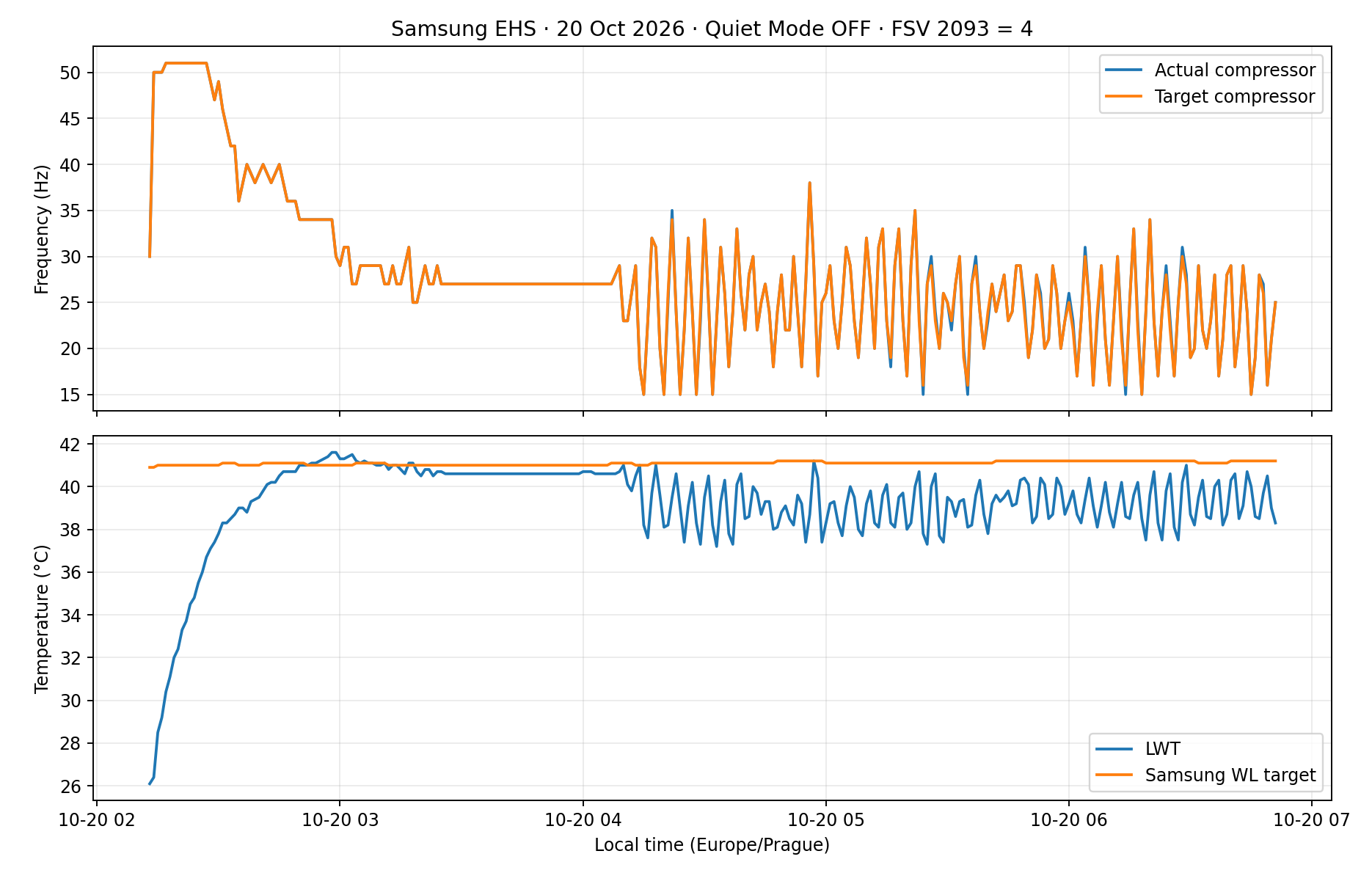
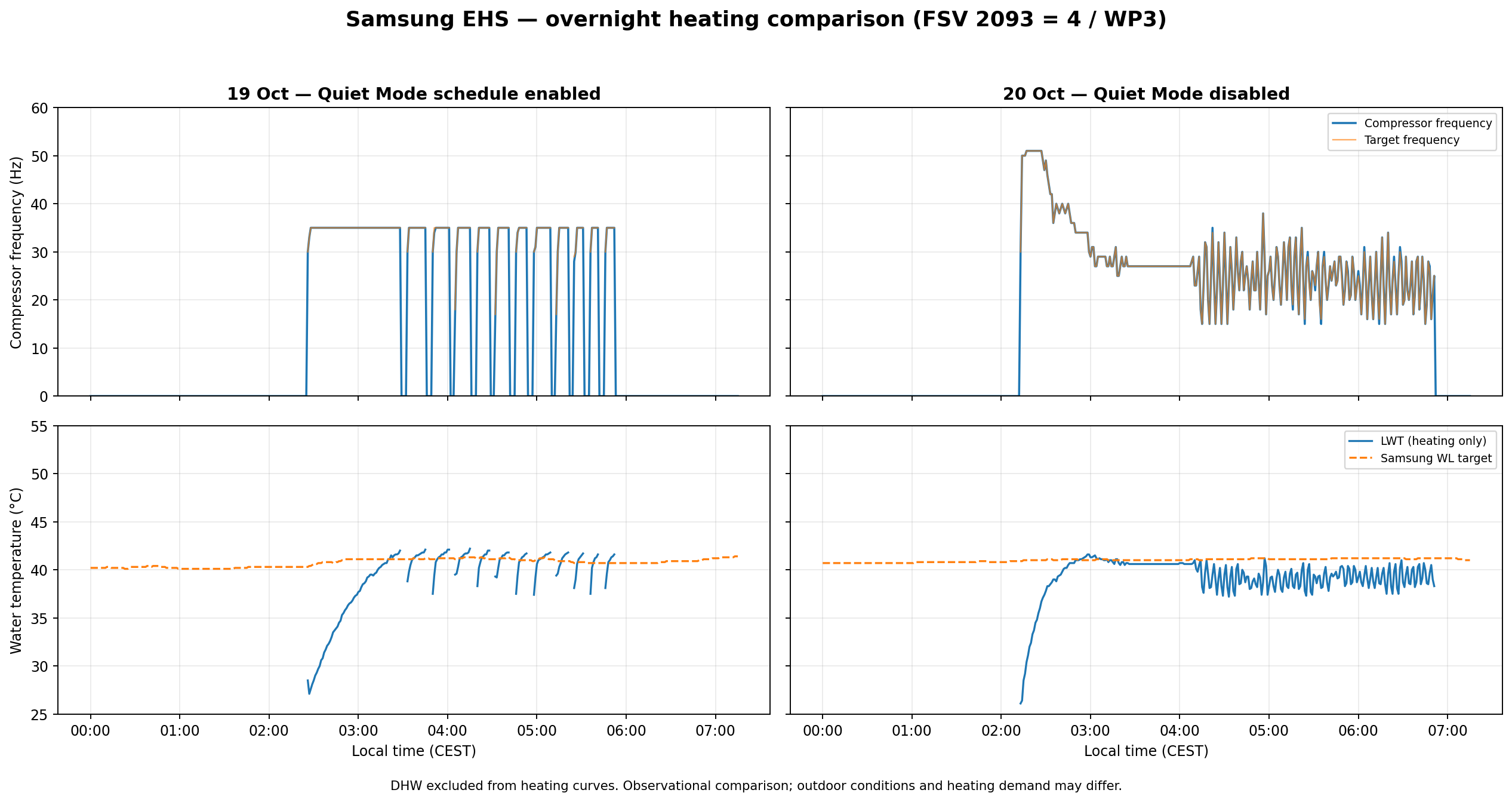
In September, the compressor regularly modulated down to 15–25 Hz during long heating cycles.
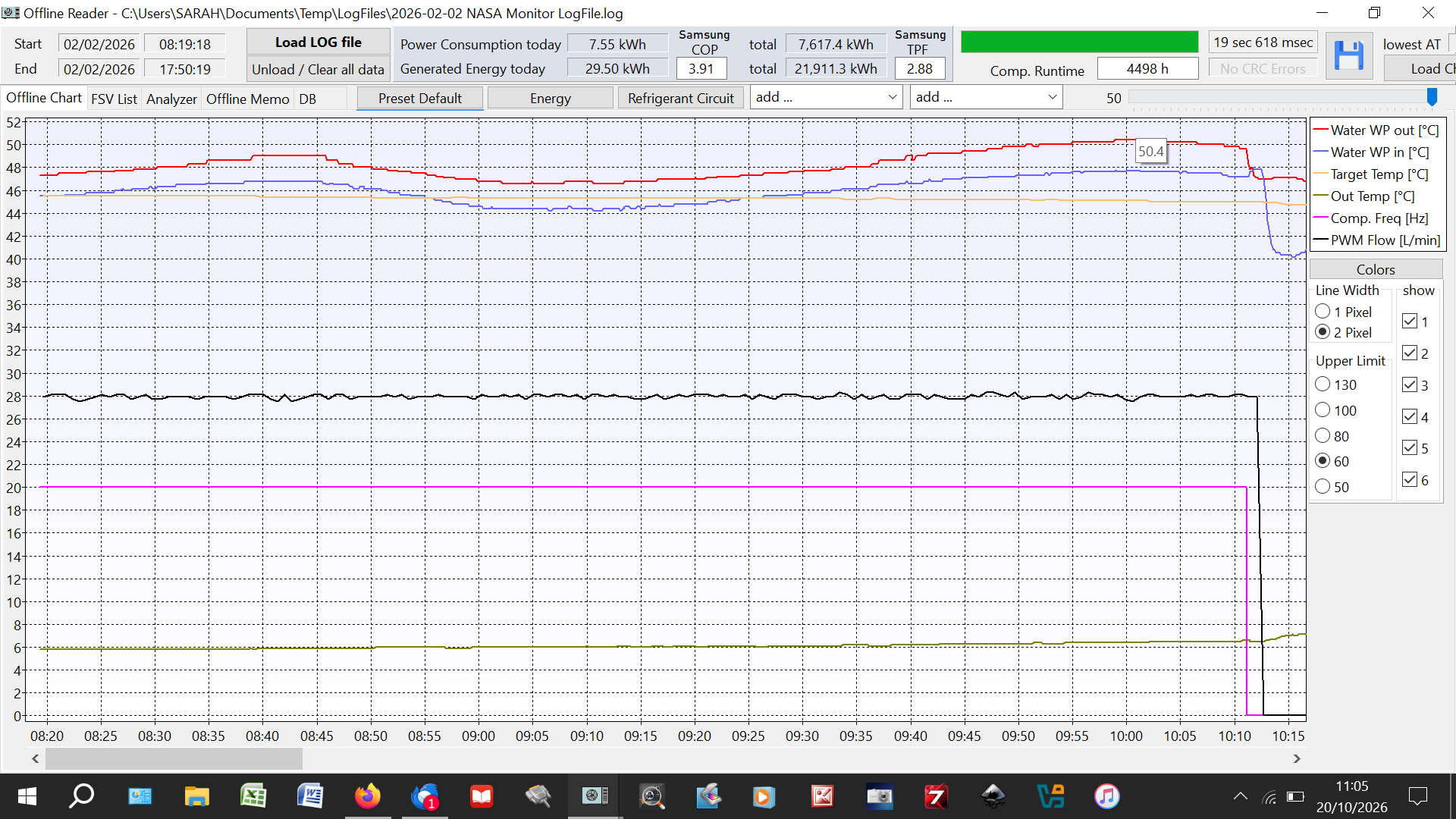
However, during several recent heating cycles in October, the compressor remained at 35 Hz almost continuously.
What concerns me is that the water outlet temperature continued increasing well above the calculated Water Law target, without any corresponding reduction in compressor frequency.
For example, during the night of 12 October, the calculated Water Law target was approximately 40 °C, while the actual outlet temperature reached approximately 48 °C.
Despite this, the compressor continued operating at 35 Hz.
Both the reported target compressor frequency and actual compressor frequency were 35 Hz.
This suggests that the compressor was following the controller’s frequency request rather than failing to reduce its speed.
3. Comparison of three heating cycles
I compared three long heating cycles at almost identical outdoor temperatures.
| Parameter | 26 Sep 2026 | 28 Sep 2026 | 12 Oct 2026 |
|---|---|---|---|
| Heating duration | 257 min | 241 min | 290 min |
| Average outdoor temperature | 7.43 °C | 7.49 °C | 7.72 °C |
| Average compressor frequency | 24.13 Hz | 25.97 Hz | 34.92 Hz |
| Minutes at ≤25 Hz | 160 | 116 | 1 |
| Minutes at exactly 35 Hz | 40 | 62 | 288 |
| Average outlet water temperature | 37.78 °C | 38.96 °C | 44.98 °C |
| Calculated Water Law target | 40.33 °C | 40.31 °C | 40.20 °C |
| Average water flow | 19.7 l/min | 20.9 l/min | 25.2 l/min |
| Average electrical power | 1,341 W | 1,478 W | 2,214 W |
| Estimated COP | 3.77 | 3.72 | 3.41 |
The Water Law target in this table is calculated from my configured heating curve. It is not a confirmed internal target value read directly from the Samsung controller.
The difference is quite surprising.
At almost the same outdoor temperature, the September cycles showed normal modulation and relatively low outlet water temperatures.
In October, the compressor remained at 35 Hz, with much higher outlet water temperature and electrical power consumption.
4. DHW operation has been excluded
I specifically checked whether domestic hot water heating could explain the differences.
All three reference cycles were verified against the minute-by-minute Samsung NASA data.
For each cycle:
-
Space heating was active throughout the cycle.
-
DHW heating was inactive.
-
The DHW three-way valve remained in the space-heating position.
-
Operating-state data was available for every recorded minute.
-
No DHW operation was detected during the 10 minutes preceding the cycle.
Therefore, the comparison is based on space heating only, not DHW operation or transitions between heating modes.
5. What I have already investigated
I’ve also reviewed historical data from September and October 2026, as well as data from the previous heating season.
Some observations:
The compressor can operate well below 35 Hz.
I have repeatedly observed stable operation at 15–25 Hz.
Low outdoor temperature alone does not explain the behaviour.
On 26 September, the compressor operated at or below 25 Hz for 160 minutes, with an average outdoor temperature of 7.4 °C.
On 12 October, at an average outdoor temperature of 7.7 °C, it remained at 35 Hz for 288 out of 290 minutes.
The problem is not permanent.
On 10 October, the compressor again modulated normally, reaching approximately 15–20 Hz.
Therefore, it does not appear to be a permanent restriction preventing the compressor from operating below 35 Hz.
Room temperature control appears to work normally.
With FSV 2093 = 1 and a room target of 22 °C, heating continues until the room reaches approximately 22.9 °C.
However, during the problematic cycles, the outlet water temperature can be significantly above the calculated Water Law target for several hours before the room thermostat eventually stops heating.
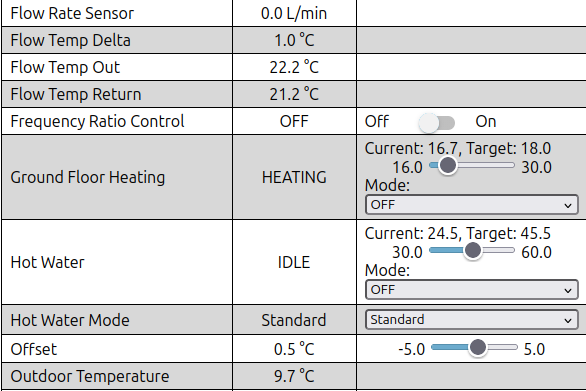
Water flow is also different.
During the well-modulated cycles, average flow was approximately 20 l/min.
During the prolonged 35 Hz cycle, average flow was approximately 25 l/min.
I don’t know whether this is a cause or a consequence of the different operating behaviour.
6. My questions
I’d really appreciate any insight from people familiar with Samsung EHS compressor control and NASA protocol data.
1. Has anyone experienced similar behaviour?
A Samsung EHS compressor remaining at approximately 35 Hz for several hours, even though the water outlet temperature is significantly above the calculated Water Law target?
2. Are there internal compressor operating modes or limitations that can temporarily prevent modulation below 35 Hz?
For example, minimum frequency restrictions depending on operating conditions, outdoor temperature, refrigerant conditions or other internal control parameters?
3. How should compressor modulation behave with FSV 2093 = 1?
My understanding is that Water Law still determines the target outlet water temperature, while the Samsung room thermostat determines when heating is switched off.
Should the compressor normally reduce its frequency when the outlet water temperature approaches or exceeds the Water Law target, even if the room thermostat continues requesting heat?
4. Is there a Samsung NASA register that exposes the actual internal Water Law target?
This would be particularly useful.
Currently, I calculate the expected Water Law target from the configured heating curve, but I would like to verify what target the Samsung controller is actually using.
I’m also interested in any available registers for compressor limitations, control mode, or reasons for a particular target compressor frequency.
5. Could water flow affect this behaviour?
Could the difference between approximately 20 and 25 l/min explain why the compressor sometimes modulates normally and sometimes remains at 35 Hz?
7. Available data
I have extensive minute-by-minute historical data collected through ESPHome and the Samsung HVAC NASA interface, including:
-
Actual compressor frequency
-
Target compressor frequency
-
Outdoor temperature
-
Water outlet and return temperatures
-
Water flow
-
Calculated thermal output
-
Electrical power consumption
-
Space heating status
-
DHW status
-
Three-way valve status
-
Room temperature
-
Calculated Water Law target
I can provide detailed graphs comparing a normal modulation cycle with a prolonged 35 Hz cycle, or share relevant CSV excerpts.
I haven’t changed any settings yet because I’d prefer to understand the control logic before experimenting.
Has anyone investigated this type of behaviour, or does anyone know which internal Samsung parameters might explain it?
Thanks in advance for any advice!
 .)
 .