I have been running my Samsung HTQ for a year now. I just wanted to share my experience with the Samsung MIM remote controller to achieve the lowest possible running cost.
Some have complained that the Samsung controller MIM appears to have too high a hysteresis of 2 degC and they have resorted to external thermostats but I think this is a misunderstanding of its operation. The 2 degC tolerance band is an important feature for the Samsung controller to modulate within rather than the inefficiency of on/off operation.
From my own observation I can see the MIM thermostat controller combines water law (weather compensation) with modulation of heat pump output…(provided it has the recent firmware)
If I set the normal rate room temperature to 19C and then at the start of each of the three ‘cosy’ half price periods I set it to 1.5 deg below the main target e.g. 17.5C. It will not turn the heat pump off if the room temperature is still within 2C of target but will instead set a new target progressively modulating the output. This reduces power consumption to 800W by reducing LWT to nearer the lowest weather compensation you have set. This avoids a shutdown so the heat pump runs continuously and efficiently with a higher COP during the normal rate periods and then progressively running harder during low rate periods storing up heat in the building.
Is this what others have found? It does depend on the weather compensation being set correctly and the emitters being balanced for the heat pump. This method of heating the house continuously whilst using mostly half price tariff by modulation is a bit of a game changer for me. It means the average annual cost of heating can be less than 6p/kW when full price electricity is 28p/kW. This is especially true if a you have the benefit of sufficient battery storage to bridge the evening 4pm to 7pm peak rate period.
This works somewhat. But the Samsung controller does not have what I’d call “load compensation”. It cannot adjust the WC curve based on the target room temperature vs actual temperature. Therefore, to make use of Time of Use tariffs in this way, you have to set the WC settings based on the cheap period, where is trying to overheat the property, but this means that during the standard periods, it is still trying to overheat the property, but turns off when it hits a room temperature limit. This is generally a very inefficient way to use a heat pump, but could still save you money.
An alternative method is to use AUTO & Water Outlet temperature mode, instead of Indoor Temperature mode. Which uses pure weather compensation, and ignores the indoor thermostat completely.
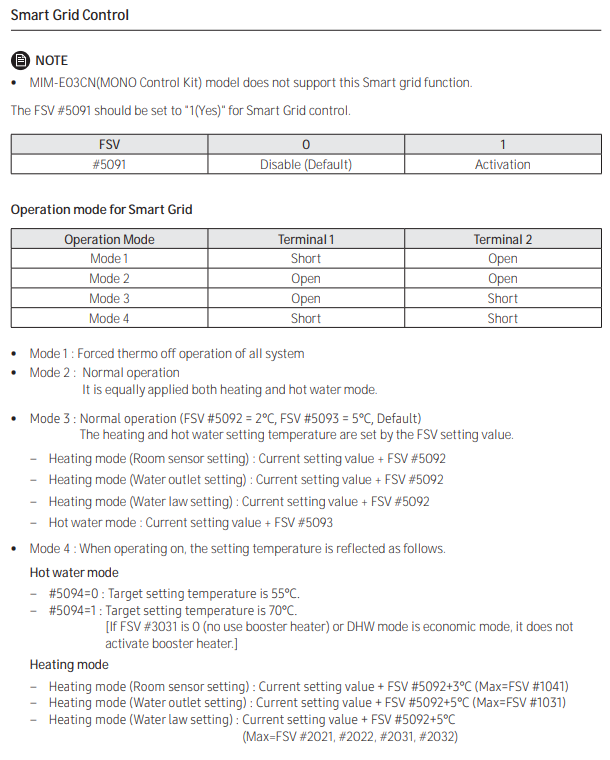
This alone, doesn’t work well with TOU tariffs as you cannot schedule increases or decreases in the WC curve (though you can adjust it manually on the MIM), but you could make use of the Smart Grid feature, which raises the target outlet temperature in 2 steps (see image below of manual). This can be controlled externally with smart relays wired into the controller. For this, you need MIM-E03EN or MIM-E03FN, not MIM-E03CN)
Another alternative is to schedule quiet mode during the standard cost periods. No one seems to fully understand how Quiet mode works, but from some testing I did over the weekend, it seems to lower the water outlet temperate target by 1-2 degrees. The issue with this is that it seems really variable and inconsistent.
I’m on Agile, but am going to be trying the Smart grid idea this winter to give a night time setback. I have a large water volume, so it doesn’t respond well to frequent changes in target flow temperature, and neither does the Samsung controller itself, (which is what I think tripped up Homely when I was using that & the Cosy tariff last winter), but I’m hopeful.
I will look into the smart grid feature. My observations did fool me into thinking the LWT dropped two degrees below the WC curve when I reduced the target temperature but it may have been coincidence.
I suppose alternatively it is possible to tamper with the external temperature sensor with a pipe heater during peak rates to lower the WC curve. That does interfere with frost protection of course but easy to try out.