Balancing underfloor heating

We’ve just moved into a new build bungalow which is heated by a Air Sourced Heat Pump feeding water under floor heating.

It has 4 room thermostat and 8 feed pipes (plus 8 return) feeding from the manifold, and each balanced by rotameter flow valves.

All of the room stats are set to the same temperature, but there is an imbalance in the rooms reaching and maintaining temperature, so I wanted to check, and if necessary balance the individual and overall flow rates.

I have a IR thermometer gun, and thought that measuring the individual flow and return temperatures, and noting the difference between would give me a good indication how much heat is being dissipated by each UFH branch, but then… I’m new to this stuff, and it’s probably not as simple as that :face_with_raised_eyebrow:

Any advice please?

It’s also about how many UFH loops there are in the different rooms /zones and how much each room loses heat.

If ‘they’ did the calcs well, the loops would be tailored to each rooms heat loss.

Floor coverings can affect the output. A too high tog carpet can smother the heat output. Stone / tiles work very well at emitting.

Hopefully ‘they’ factored that in too.

Even a large thick rug or mat will lower the output a bit..

Are the individual room thermostats playing in and over controlling?

We have no room thermostats, the water is fed to all rooms at the same temperature including one large triple rad in an annexe.

By controlling the flow to the zones (almost the same as rooms), we can get the ideal temperature over the whole house (2 story).

The rad is totally flow open.

I carefully spec’d the annexe room to make sure it would provide enough heat with the low UFH water temp for the rooms calculated great loss. It worked.

The tiles floor kitchen and hall are flow throttled back quite a bit.

The lounge with low tog carpet requires most flow.

The upstairs is throttled back.

I point my temp gun at the floor to compare the outputs and go from there.

Not sure it’s very scientific, but it worked.

At this time, the rooms don’t need any heating until the temp drops below 20.5 degC, and different rooms kick in at different times.

About 4am - 5.30am over past few nights, where the temp then continues to fall whilst the heat permeates the floor mass. Once below 20.5 deg, the UFH continues to heat until the room temp reaches 20.8 deg.

The heat pump is programmed for a flow temp of 35 degC, but I’m measuring 32 deg at the manifold (due to buffer tank ???).

But I’m drifting off topic a little here because I’m really asking about balancing the loops.

Balance of the UFH loops is pretty easy. More flow gives that loop a higher heat output, conversely lowing the flow rate decreased the output.

But you really need to step back a few steps. Your flow temp needs to vary with outside temperature (weather compensation) this will mean floor output is more matched to demand. So I would set it up (read your manual) this will also reduce running cost.

UFH I would setup as follows

Open all loops fully at the flow meters. Then reduce your secondary pump speed until most loops read around 2 to 2.5L/min. Flow rates will vary a little by loop length, if you have a short loop that loop will want to flow at a higher rate, reduce the flow for that loop at the flow meter.

Now remember UFH is a slow heating system, room temps shouldn’t respond quickly - should take a few hours. Now monitor the heat temperature response, when heating is on. If the rooms are coming up to temps quickly your flow temp is too high. If individual room are faster than others the balance is off.

You are wanting the least system resistance (so pumping losses are the least) so move the least amount of flow meters as you can. So most rooms come up together the odd room that gets quicker than the rest you reduce that loop flow at the flow meter for that loop.

You may find the above easier to do with the thermostat set at 26, the whole idea is the lowest flow temp to keep the house temp stable, when setting up the thermostat gets in your way. The thermostat is there to do a little fine tuning, but generally a well setup UFH system in a modern house doesn’t need thermostats, as floor temperature is pretty close to the room temperature.

The most significant potential flaw in that design could be that the thermostats all operate individually and so could “call for heat” in single rooms in an uncoordinated “on/off” pattern instead of acting in concert. If that’s the case, then it risks forcing the heat pump to run at or below its minimum power output, causing it to cycle on/off, reducing efficiency and causing premature wear (much like only driving a combustion engine car on short trips) and potential failures. If it is a model of heat pump which can be easily integrated with open energy monitor then this would be a good thing to do so that you can see what’s going on.

These are very connected statements, I would say your flow temp is way to high unless baltic outside. What is happening, you are pushing heat in to the floor its being absorbed, but you are pushing too much heat into the floor and getting overshoot. What you need to do is introduce WC in to the system, so a 10 degs you are flowing say 26 to 28 degs, that will limit the over shoot.

Also the 35 one side of the buffer and 32 the other says your flow rates at either side of the buffer are not matched and you are getting distortion, it mixing the contents of you buffer. Assuming your secondary pump is at fixed speed, you could change the primary pump to fixed speed and flow match to the secondary pump. Or better still delete the buffer at some point, but having the flows the same is a good first step

I agree with the above.

It could be that the thermostats are pulling and shutting down individually..

When I had our one thermostat controlling, it was very unsatisfactory! On / Off, too much hysteresis to be useful..

A temporary fix was to set impossibly high and then tune the system to actually supply what’s needed in water temp for the heat loss (depends on outdoor temp causing property to lose heat).

I assume you have a weather curve setting and can run on Leaving Water Temperature?

What I would try is to set all the room thermometers to impossibly high (while system is off.
Or disable all the thermostats in the controller and go Leaving Water Temperature.

Then set to Leaving Water Temperature and adjust the Weather Curve something like this..

At -9°C outside LWT is 43°C
At 13°C outside LWT is 25°C

I tried to upload a pic but can’t..

This is of course for our house and conditions.
South England, UFH, haouse built 10 years ago..
You then adjust the flows on the manifolds to each zone to achieve a stable whole house temperature.
Can have warmer downstairs and cooler upstairs like this.

We rarely see sub zero, but if we did see -9°C the Heatpump would output 43°C water.
During the shoulder months it spends much more time at the other end of the curve..
Right now it’s 11 or 12°C outside and the leaving water temp is 27 - 28°C.

What you get is a nice stable temperature throughout the whole house and no on offs.

If it went to below -9°C outside I could change the Weather Curve in 20 secs to accommodate.

This may seem a lot of work, but if you value comfort and Heatpump efficiency it was the only way with our system.

Maybe yours is smarter but not there yet?

I don’t know why not - how? Drag & Drop is the easiest. What format?

FairPhone.
I had to long press and create a link.
Most sites visit have an add pictures button.

Let’s see if this worked..

Google Photos

Yes it did.

Well I set up weather compensation which lowered the flow temperature to 28 - 31 deg, but then it really struggled to reach a comfortable room temperature, especially when the thermostats had been turned off due to sunshine heating my home during the day.

I’ve read what @Johnmo & @HeatStig have kindly posted, but at the lower flow temperatures, the heat pump would be running almost continuously, surely that would create losses, and increase wear on the heat pump?

Below is a typical thermostat chart showing how it’s running (at 35 degrees), and can be seen it kicks it at about 3.30am and runs until about 8.30am, then nothing for the rest of the day, because of higher outdoor temps, sunshine on the windows (not always :wink:) and heat generated from electrical appliances, humans etc.
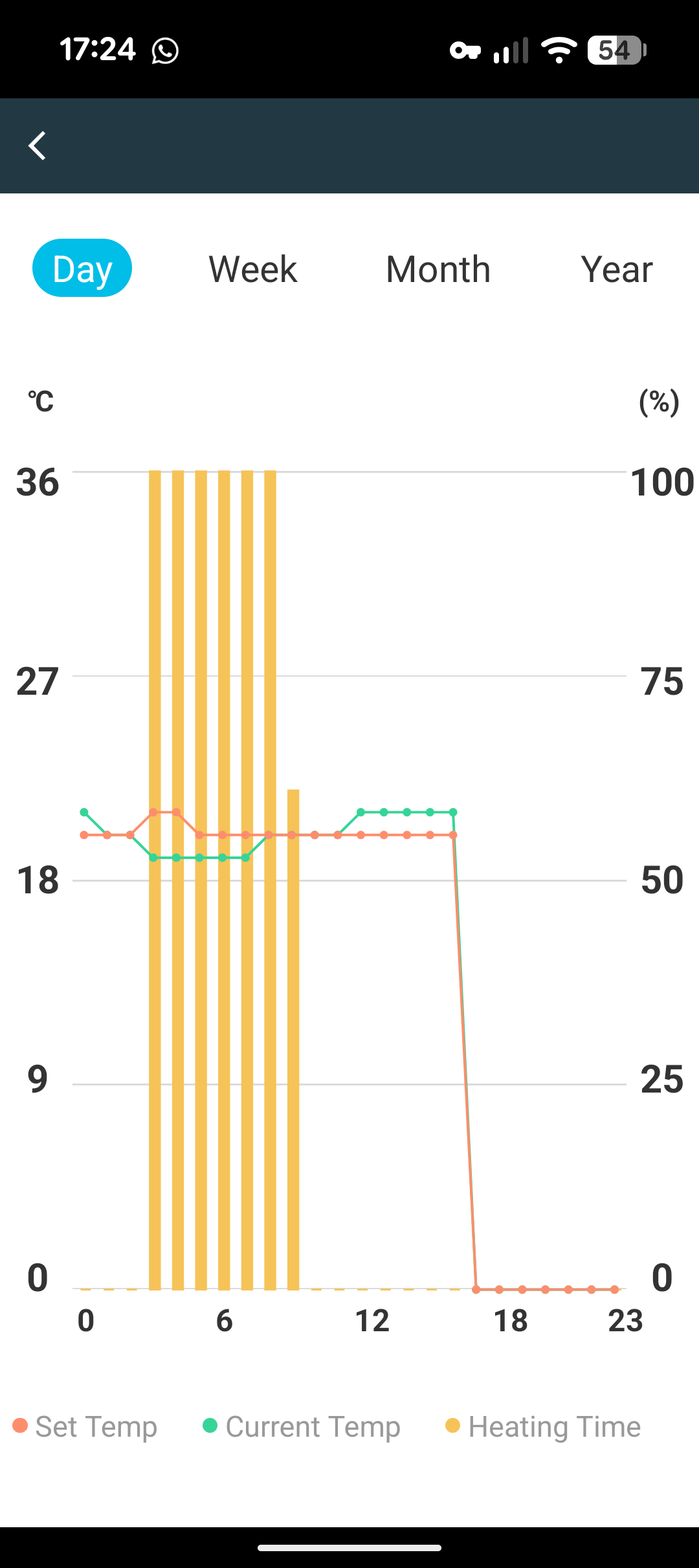
The chart isn’t very advanced, and the data lines drops to zero - because those data points haven’t been recorded yet!

Certainly would result in way less wear of the heat pump running very long periods, with all things that move, the wear occurs at start up and shut down - not in steady state conditions.

Based on your graph you under and over shoot the thermostat, most the time either above or below its set point, so your average is roughly its set point. So running the heat pump over way longer periods would not change the heat loss you would just have steadier room temps. The heat pump as it modulates down uses less electric. Plus you would be running lower temps which result in a better CoP.

I would really think of your thermostats differently, not as room temperature setting device, because as you show, they are pretty useless at that especially with UFH. Think of the them as room over heat protection. Sun comes out, room heats ASHP can go off, WC curve is slightly out and room starts to over heat ASHP goes off. So if you want the room at 20 degs, set the thermostat to 20.2, if you can adjust the the thermostat hysteresis, reduce it down to 0.1, 0.2. As the thermostat hits 20, your ASHP starts again, you will get some undershoot as UFH is slow, but if your curve about right it should hover around 20 degs anyway 24/7.

The optimum is to get to steady state.
That’s where the heat pump fan runs all the time but the compressor is only invoked as infrequently as possible as it costs more juice.
When it’s too warm outside spring and autumn solar gain, this gets disrupted as the heat pump has to shut down or the house overheats. Heat pumps can’t modulate down low enough (yet).
Your temostats are effective doing the same thing. It’s the way gas boilers have always been working. But it’s not what a heat pump can do and be efficient.

When it’s colder outside the fan will run all the time and the compressor will kick in from time to time to make heat. That (and the above shoulder month working) is normal, designed to last for 15+ years.

I’m coming round to both of your ways of thinking, and have implemented Weather Compensation again, and will see how things go for a few days.