I have had my Samsung HTQ working very efficiently for over two years now and in that time I have drained it several times for upgrades to radiators and house improvements. As such it would have been wasteful to be glycol filled and I understand not many UK installations are (correct me if wrong here). I am concerned that if a power cut occurs we are at risk of considerable and costly damage. We are in a remote area and certainly get lengthy power cuts at times so it may just happen this winter.
My proposal is to use a standard portable power pack or UPS connected to just the MIM controller circuit. As I understand it that will run the external pump continuously in low temperatures. If that does not work then I could power just the pump but that would require some manual intervention. My question is do we consider running the pump as sufficient to prevent frost damage? If so has anyone found an easy way of providing an automatic way of providing power to the pump in the event of a loss of grid power?
Or is filling with glycol the only way to ensure frost protection without using a dump valve so normal operation can resume when power is restored?
When considering backup power for the pumps, I think that if you powered the MIM circuit that may not work, as the controller will likely throw an error code when it cannot detect the outdoor unit as being online, due to the power cut.
So any solution would likely have to involve just powering the pumps directly and working out some form of control. You do not need to run the pumps continuously - Samsung only run the pumps for ~5mins every hour when the temperature is below 5C.
How many circulation pumps do you have? I have two Wilo pumps fitted to my Joule pre-plumbed cylinder, and they are rated at 50W each, less if run at slower speeds. Assuming they draw around 70W, a regular UPS may not last that long if running continuously. I’m thinking about my PC UPS which only lasts for about 20-30 mins in a power cut, and my PC is probably not drawing much more than those pumps.
Do you know how much the outside unit and MIM/indoor circuits draw in standby? If you could power the lot from the UPS then that may resolve the communication error code issue, but if the ASHP kicked in it would flatten the UPS immediately.
For an automated solution, you could use a Rasp Pi with sensors to detect a power outage and activate the pumps for a short 2min burst every 60mins - you really only need to move enough water to fill the external primary loop with warm water from inside.
Yes I can see that the MIM on its own will just stop with an error and I would probably need to use a solar battery as the backup for all of the ASHP even then it would not last that long.
I like your solution of using a low cost controller sensing the loss of power and temperatures below 5C then switching my Grunfoss pump direct to a small power pack for a few minutes every half hour or so . That would potentially last through an extended power cut and normal service would be resumed afterwards. I have programmed Raspberry Pi Pico units for something similar and if we think this is a useful solution I will have a stab at it…
You might also make an insulated cover for the outside unit for use during extended power cuts.
Just put anti freeze valves your ASHP heat exchanger is protected - no need to reinvent the wheel, if you don’t want to do that just add glycol
Presumably you already have frost protection valves (FPVs) installed but don’t want them to dump your water, hence have the faff of restoring operation in what may have become a partially-frozen outside circuit during power outage.
That scenario has been my concern as I too live in an at-risk of power outage area. It would not take much of an outage on a cold day for the FPVs to operate!
My route has been linked to installing an AC-coupled battery storage unit; I elected to choose a unit which has a backup output. A change-over switch at the HP consumer unit allows this to be switched-in. I’ve not used it in anger yet, but it should be able to cope with running the HP at throttled power (this is feasible on my unit) or at least allowing it to keep the intermittent circulation operating.
I suspect you’ll either need to provide enough power to keep the unit operating as normal but with the house thermostats right down, or hack the pump power circuits to allow a switch-over to drive them from UPS rather than under HP control.
Thanks for the posts. As some of you have noted my aim is for this to be fully automated for when the property is empty. An FPV dump is a small disaster in a remote empty property leaving the house unheated (although it is set to a trickle maybe that will not be a disaster if there is a refilling header tank) . Glycol is the obvious choice but it does have drawbacks. ASHP backup in an outage that is automatic would be expensive and complex for me although do-able.
My original question was mainly 'Do we think just having the pump running intermittently in a power outage is a sufficient frost protection and has anyone tried it?
If it works then it would seem to be a cost effective alternative to glycol as an automatic protection for a vacant property.
Interesting comparison of FPV anti freeze valves vs glycol here Can Anti-Freeze Valves Replace Glycol In A Heat Pump System? anyone had them function in a power cut? and how long to get the heating back working again?
If you want a usable alternative
- add a secondary pump, set to min speed it will draw about 10W.
- hook up to a battery backed UPS,
- Add a frost stat in to the power loop
- Then you just need a relay that goes closed when the grid goes off. So grid holds it open then closes when grid removed, grid back on again pump goes off.
Normal operation pump.is there and it will free wheel away in the normal flow. Frost stat makes and grid off pump starts to move fluid about stops freeze occurring
A Fogstar battery with 3.6kw inverter can move most electricity useage to of peak, so cover it’s costs in a few years. So what about getting a battery that is 5kwh larger than you would have otherwise, than set it up so the last 5kkw is only used in a power cut for the heatpump in low power mode?
(Would need to occasionally completely discharge and than hold at full charge to keep BMS happy.)
As well as stopping antifreeze values operating there is an issue with restarting an heatpump when there is too little heat in the CH loop for a defrost and very cold outside. Not all heatpumps will automatically use the DHW tank for a defrost when the CH loop is too cold, so just turning on the DHW emergency heaters when you get electric back may not be enough. (May auto get defrosted issues if home thermostat is set at 5c to stop freezing and flow temperature does not have a sensible minimal.)
This is what I am proposing to use to operate the main circulation pump for 5 minutes every hour or so whenever a power outage occurs below 5C.
There is an adjustable timer module available so no need to design anything from scratch (although its relay will need uprating to 3mm gap contacts). I already have a small power pack that should provide a day of backup at this very modest duty cycle. It is, of course, dependant on the residual warmth from the house circulating at intervals is sufficient to provide the frost protection required and without the dreaded FPV coolant dump being triggered. (or just leave out the FPV’s and save money!)
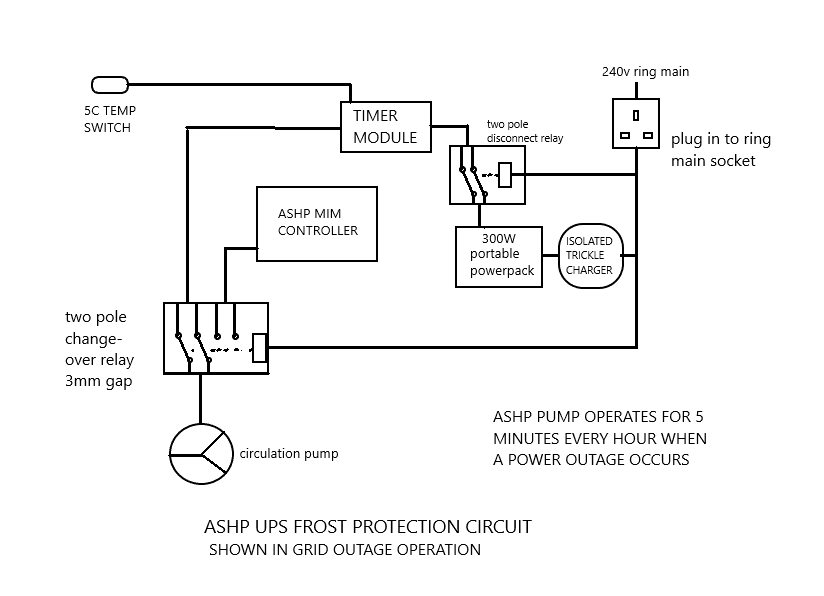
updated to show two pole changeover relay and power pack in place of UPS
There are two types of anti freeze valves one that measures the water temp and others that measure ambient temp, you don’t want the later ever.
Other than that it looks like it would work, all zero reliance on smart tech, which is best
How will you make the earthing safe?
I don’t know any suggestions/recommendations welcome. I was going to bond the UPS chassis to earth, will that be sufficient or will that cause a problem? Also intend to double pole the live and neutral relay switching, not shown in my diagram, to prevent neutral feedbacks to controller. Addition of the appropriate fuses as well of course. Anything else?
Earthing:
Will the UPS etc be located inside the house?
What is the earthing system on your present installation? See Earthing system - Wikipedia
Will the UPS etc be located inside the house?
Also bear in mind you need 3 mm air gap between the contacts on the relay that switches the pump.
The house consumer wiring is TN-C-S (PME - Protective Multiple Earthing). The neutral and protective earth are combined in a single conductor (the PEN conductor) and the earth split out at the consumer unit. All the metal pipe work is earthed and was checked by an electrician. The pump and UPS is located inside the house. I was intending to plug the UPS directly into a nearby ring main socket inside the plant room. The wiring between the pump and MIM controller would be switched using two pole contactors - 3mm gap contacts noted thanks. I have updated my crude diagram.
Does that sound ok?
If the UPS requires an earth connection, then you will pick it up via the 13 A socket. If there is a risk that it could be unplugged in operation, then you should organise a permanent earth connection to a local convenient mains earth. The pump, if it requires an earth (i.e. it is not double-insulated), should get it via the heat pump, so you should maintain that earth – even if you also have a parallel earth via the pipes. I can’t see an earth on the timer module; if I’m right, then if it’s in a plastic box or an earthed metal one, it should be OK.
What you won’t want is a second neutral-earth connection, because that is very likely to give you nuisance RCD trips.
Remember the power cut may be due to the neutral being damaged. PME needs to be replaced with your own earth spike etc to make a UPS safe (other than for double insulated computers)
You are unlikely to have access to the correct test equipment to confirm an earth spike is correct. This is not a DIY level job…
Thanks for the safety advice it is why I post on this forum.
Here is an alternative manual approach to consider…
If in a cold weather outage I unplug the circulation pump and plug it into my portable power pack, which I keep for such emergencies (rather than a UPS), and run the pump once every hour to stop the ASHP from freezing would that be a safe DIY solution do you think?
It is a shame that this cannot be automated however I have modified my diagram above to replace the UPS with a power pack and isolator if that is now a safe solution.
I would want a length of plastic pipe on each side of the pump. (Shame you don’t seem to get double insulated pumps.)
Without a source of heat, you will run out of stored heat to keep the outside pipes warm.
A 2nd pump connected with plastic pipes to bypass the main pump with none return valves may be an option. Depending on battery system run as DC, or put in the full correct automatic change over switch with a seperate consumer unit for all important loads.
Getting the property professionally converter to TT would be my choose with a traditionally of grid hybred inverter.
‐–
These questions will become more common as people get cars with V2L, a 3kw V2L is unlikely to run most heatpumps even in low power mode (due to start up currants) but could run seperate pump with 1kw inline heater.
Makes you wonder is glycol the answer, not something I like, but a suitable solution in this situation. Almost fit and forget.